Pliny to Calpurnia · High Roman Empire
The Empty Threshold
She is in Campania for her health. He rereads her letters, walks to the room where she sat, and writes as if the wax could keep her. Her side of the correspondence does not survive.
Pliny the Younger (Gaius Plinius Caecilius Secundus)Calpurnia
Comum (Como)
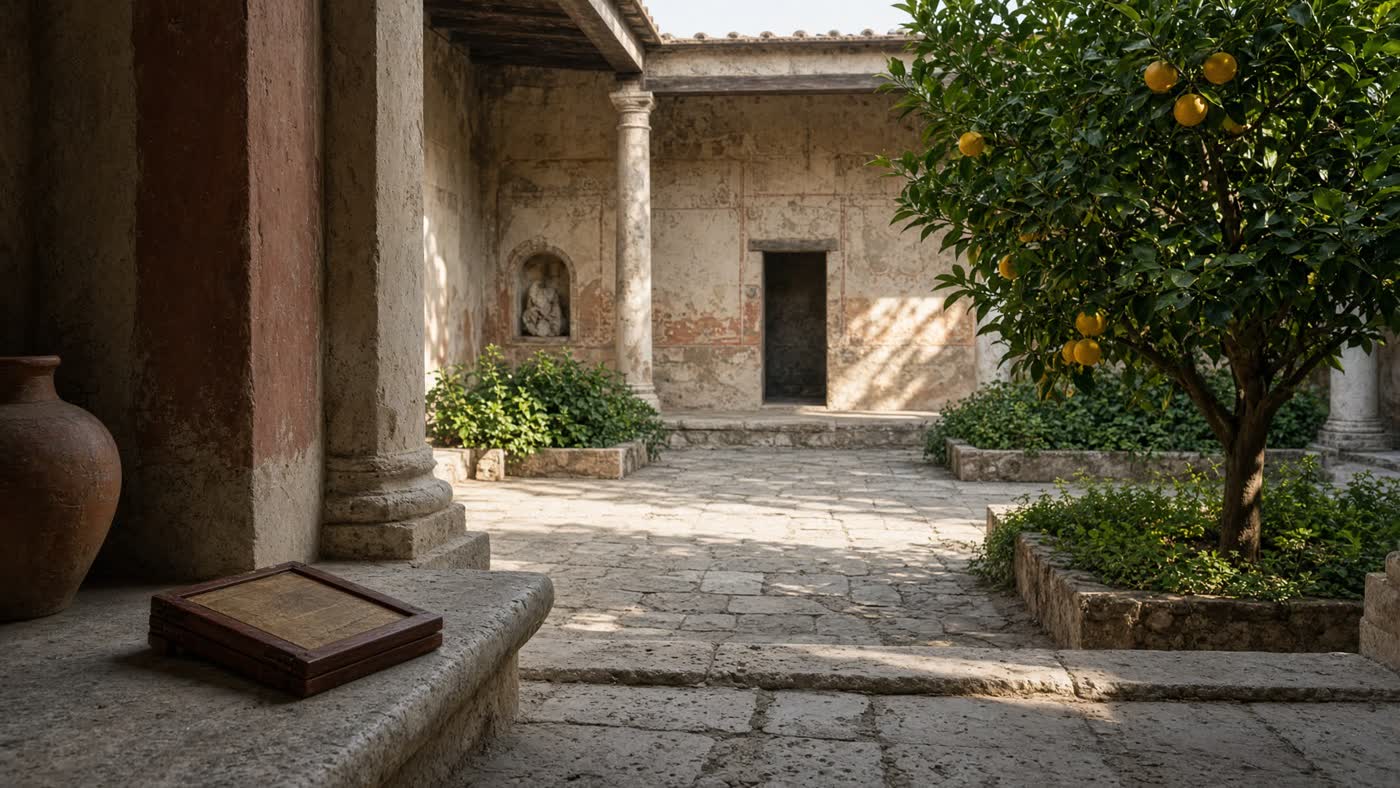
Gaius Plinius Caecilius Secundus, Pliny the Younger, married Calpurnia, granddaughter of Calpurnius Fabatus, as his third wife. She was younger. He was a senator who liked to be seen as a man of feeling. The letters he later published include three to her when she is away in Campania for her health: Epistles 6.4, 6.7, 7.5, written around the first years of the second century. They are marital, tender, and elite. They are not a census of Roman marriage.
In 6.4 he cannot follow her. He wants to see with his own eyes whether the air, the quiet, the plenty of that country are doing what the doctors promised. Uncertainty, he says, is itself a sickness. He asks her to write every day, twice a day. He will be easier while he is reading. Afterward the fear will start again. This is not drama. It is the timetable of a nervous love that has clerks.
In 6.7 she has written that she misses him and that she takes consolation in his works, putting the books where the man is not. He is glad. He is also exact: he reads her letters over and over, as if they had just come, and the rereading only sharpens the want. How sweet, he asks, must the conversation be, if the letters have this many charms. We have his account of her page. We do not have her page.
7.5 is the letter the archive cannot put down. He lies awake. By day, at the hour he used to visit her, his feet take him to her room. Finding it empty he turns back, sick, like a lover refused at the door. The only rest is the bar, the suits of friends, work as anaesthesia. Judge, he says, what my life is, when I find my repose in toil.
A published letter is a performance as well as a pulse. Pliny knew he would be read. That does not make the empty threshold a lie. It makes it a fact that passed through style. Calpurnia, away, remains a person we meet in his sentences. Roman wives of other ranks, enslaved partners, marriages without this ivory quiet, they are the silence around his tenderness. The archive keeps the letter. It does not let it stand for Rome.
The letter
To Calpurnia, in Campania
You kindly tell me my absence very sensibly affects you, and that your only consolation is in conversing with my works, which you frequently substitute in my stead. I am glad that you miss me; I am glad that you find some rest in these alleviations. In return, I read over your letters again and again, and am continually taking them up, as if I had just received them; but, alas! this only stirs in me a keener longing for you.
Translation · William Melmoth (public domain) · Pliny, Epistles 6.7, English in the Melmoth public-domain tradition
You will not believe what a longing for you possesses me. The chief cause of this is my love; and then we have not grown used to be apart. So it comes to pass that I lie awake a great part of the night, thinking of you; and that by day, when the hours return at which I was wont to visit you, my feet take me… to your chamber, but not finding you there, I return, sick and sad at heart, like an excluded lover.
Translation · William Melmoth (public domain) · Pliny, Epistles 7.5, English in the Melmoth public-domain tradition, abbreviated
Atlas plate · High Roman Empire
The Empty Threshold
She is in Campania for her health. He walks the rooms where she sat.
From one shore toward the other. A path of relation, not a lineage.
From
Between
Toward
Placement is approximate where the record is not a surveyor.
- From
- Comum, on the lake in Cisalpine Gaul
- Toward
- Campania, south of the city
- Between
- the Italian peninsula, roads, villas, the length of a married absence
- Distance
- about 560 km of land that can be named and still not crossed tonight
- Obstacle
- her health, his office, the ordinary distances of empire
- Beloved
- Calpurnia
- Approximate route
- down the peninsula from the lakes toward the southern shore
- Time apart
- the season of her convalescence
- Message delay
- wax, a courier, the wait for a letter in her hand
- What stands between them
- rooms she has left empty, and a correspondence of which only his side survives
Pliny, Epistles 7.5, public-domain English after Melmoth.
my feet take me… to your chamber, but not finding you there, I return, sick and sad at heart, like an excluded lover.
What happened next
Calpurnia’s letters are lost. We know she miscarried; we know Pliny wrote of her to her aunt Hispulla with pride in her attention to his work. The marriage, as far as the published correspondence shows, continued. History does not owe us an ending in Campania.
Distant echoes
Echo
The Cloud MessengerThe message asked to do the work of presence.
Counterpoint
A Gossamer LifeAnother marriage recorded in absence, without this tenderness, and without his talent for being seen to suffer well.
Source / evidence
- Pliny, Epistles 6.4, 6.7, 7.5·Latin letters to Calpurnia. Also 4.19, to Hispulla, on the marriage. Standard numbering of the nine-book collection.
- William Melmoth, Letters of Pliny·1746 English, public domain; later printings (including Gutenberg) circulate this version. Quoted in brief.
Pliny’s Latin is ancient. The English below follows the public-domain Melmoth tradition as printed in later public-domain editions, quoted in brief. Calpurnia’s own letters do not survive and are not invented.
A word opens beside this story: amor
One question remains
If her letters were the only rest, what is it we hold when we hold only his?