
Kālidāsa, Meghadūta · Gupta-period India
The Cloud Messenger
An exile on a hill asks the monsoon to carry a message to a wife on a mythic mountain. The route is half the poem. Distance is not what the lovers suffer. It is what the verse is made of.
The yakṣaThe yakṣa’s wifeKālidāsaKubera
Rāmagiri (associated with Ramtek)
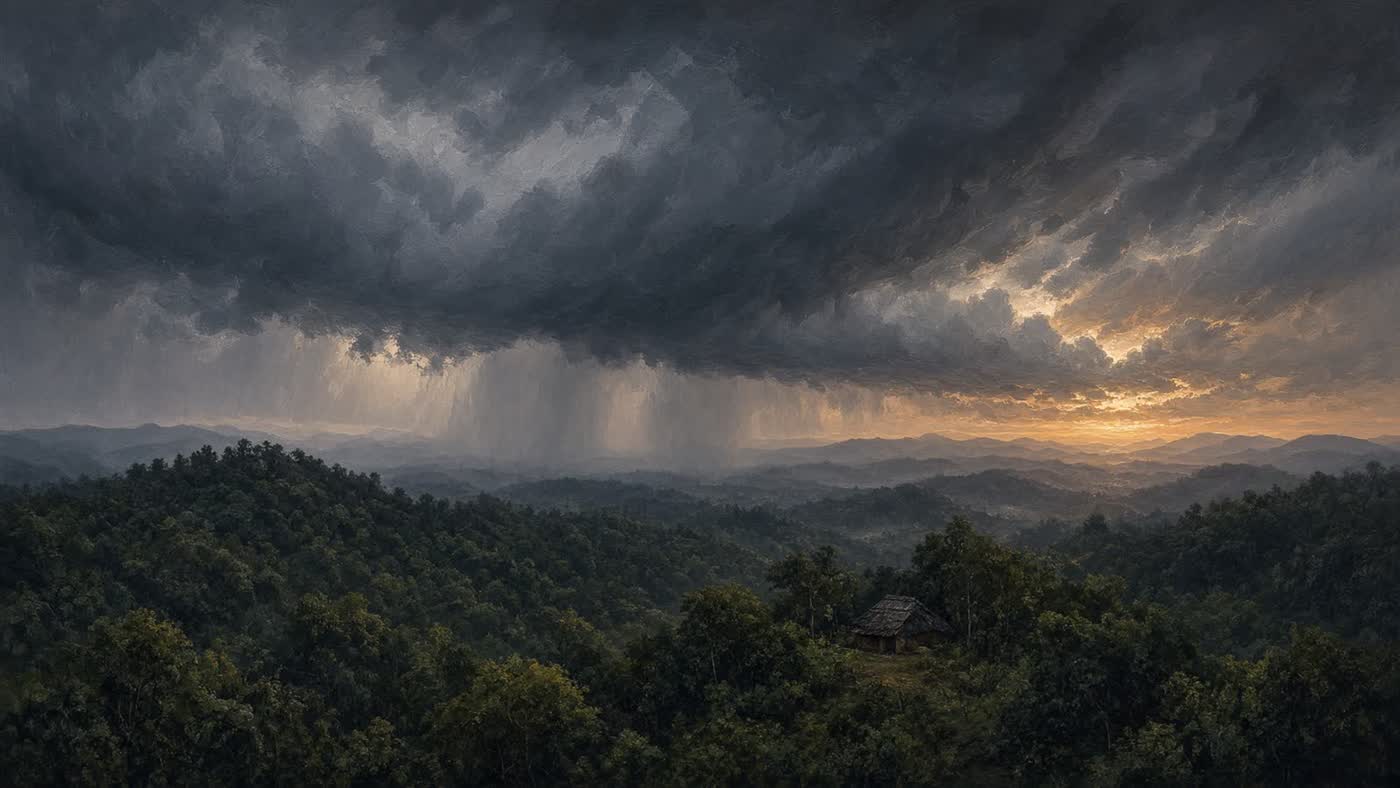
A yakṣa, a spirit in the household of Kubera, has been careless with his office. The punishment is a year of exile at Rāmagiri, a hill later associated with Ramtek in Maharashtra, among groves the poem still names as Rāma’s. His wife remains in Alakā, the city of the yakṣas on Mount Kailāsa. The Meghadūta does not open on her face. It opens on a season.
At the first of Āṣāḍha a cloud leans on the mountain. The exile, wasted with kāma and with the particular gravity of absence, sees a messenger. He addresses the cloud as a sentient kinsman, a traveller who can be taught. In Kālidāsa, distance is not an obstacle the plot will remove. Distance is the form: more than a hundred stanzas in the slow mandākrāntā metre, a geography recited so that a message might, perhaps, arrive.
The first movement, Pūrvamegha, is the route. North, then farther north. Mālā, the Vindhyas, rivers that must be drunk, the palaces of Ujjayinī where the cloud is asked to pause, not for the yakṣa’s sake only, but so that rain may belong, for a night, to the same city the wife might imagine. Named places stand in for the body that cannot be touched. The atlas is a caress that does not pretend to be a hand.
The second movement, Uttaramegha, is the message. The cloud is told how to find her in Alakā: thinner, perhaps; counting months; speaking with friends who know the look of waiting. Show a sign, the husband says. Speak of nights that were. Say that he lives. The poem is tender without being sure. A year’s sentence has a calendar. A monsoon has a direction. Arrival is not staged.
In 1813 Horace Hayman Wilson published the first English version of a Sanskrit kāvya, verse for verse, and called it The Mégha Dúta. “Where Rámagiri’s cool, dark woods extend, / And those pure streams, where Síta bathed, descend…” The English is of its century, latinate, a little proud. The Sanskrit is of a court that treated the monsoon as a literary season. Neither is a letter in a drawer. Both are a shape found for not being able to go.
Later readers have wanted the cloud to succeed, as if the poem were a postal service with a tracking number. Kālidāsa does not give the delivery. We are left with instruction, description, an imagined room on a mountain that cannot be excavated. The yakṣa remains on the hill. The wife remains, if she remains, in a city no traveller has to confirm. Longing here is not a defect in the plot. It is the plot.
The coordinates printed for Alakā are traditional and mythic. Kailāsa can be pointed at; the city of the yakṣas cannot. Rāmagiri can be walked. The person the cloud was asked to find cannot be taken from the ground. Between 21.40, 79.33 and 31.07, 81.31 there is a monsoon and a poem. That is what the atlas, in this case, is for.
The letter
From Rāmagiri toward Alakā
Go. When you see her, thinner, perhaps, the months counted on her fingers, tell her that I am here, that I live, that I have given you our nights to carry. Do not frighten her with the whole of my wasting. Give her a sign she will know, and then, if the sky allows, remain a moment so that she may speak back into rain.
Editorial paraphrase · Editorial paraphrase · Editorial English rendering of the situation of the Uttaramegha, not a stanza-for-stanza translation and not a recovered letter.
Atlas plate · Gupta-period India
The Cloud Messenger
An exile asks the monsoon to walk India in his place.
From one shore toward the other. A path of relation, not a lineage.
From
Between
Toward
Placement is approximate where the record is not a surveyor.
- From
- Rāmagiri, a hill of exile later associated with Ramtek
- Toward
- Alakā, a mythic city on Mount Kailāsa
- Between
- rivers, cities, cloud, the monsoon road
- Distance
- about 1,400 km of weather imagined as a messenger
- Obstacle
- Kubera’s sentence, a year that cannot be walked
- Beloved
- the yakṣa’s wife
- Approximate route
- the cloud’s itinerary, with Ujjayinī held as a waymark in the verse
- Time apart
- a year of exile
- Message delay
- a season. The poem is the delay.
- What stands between them
- a punishment, a mountain, and a message that does not have to arrive in order to be love
Also on the plate: Ujjayinī
The line that survived
Where Rámagiri’s cool, dark woods extend, And those pure streams, where Síta bathed, descend;
H. H. Wilson, The Mégha Dúta, or Cloud Messenger, 1813. Public domain. Opening couplet only.
Interpretation
Kāma in this poem is not a sin to be purged and not a greeting-card. It is the heat that makes a cloud into a person. The yakṣa’s error, in Kubera’s household, is official; the poem’s interest is what a punished love does with a sky.
To treat Alakā as a GPS pin is a category mistake the archive can name and still, carefully, map. Mythic destination, walked origin: the feeling of distance requires both.
Distant echoes
Echo
The Empty ThresholdAnother husband making a message do the work of a room.
Another language
Red Earth and Pouring RainRain as the form of union, Tamil, not Sanskrit, and not the same weather.
Source / evidence
- Kālidāsa, Meghadūta·Sanskrit kāvya in two movements, Pūrvamegha and Uttaramegha, mandākrāntā metre. Gupta-period dating, c. 4th to 5th century CE, is conventional rather than exact.
- H. H. Wilson, 1813·The Mégha Dúta, or Cloud Messenger: first English rendering of a Sanskrit kāvya. Public domain; quoted in brief.
Kālidāsa’s Sanskrit is ancient. H. H. Wilson’s 1813 English verse is public domain and is quoted briefly. Modern translations are not copied at length. The message in the poem is verse, not a recovered letter; none is invented.
A word opens beside this story: kama
One question remains
If the message never has to arrive, what, exactly, was the cloud asked to carry?