
Kuruntokai 40, Kapilar · Sangam Tamilakam
Red Earth and Pouring Rain
In classical Tamil, love has landscapes. A woman asks what kin her family was to his, then answers with monsoon and red soil. The poem is not anonymous India. It is akam, and it is Tamil.
KapilarThe talaivi (heroine)
Madurai region
Kuruntokai is one of the Eight Anthologies of classical Tamil. Its poems are short, attributed, and spoken through the conventional persons of akam: the heroine, the hero, the friend, the foster-mother. Akam is the interior, love, the household of feeling. Puram is the exterior, war, kings, the public boast. To fold this into “Indian love poetry” is to misfile a literature that already had a name, a landscape theory, and a city.
Poem 40 is attributed to Kapilar, a poet closely tied to the kurinji tinai: the hills, the cold air, the first union. The speaker is the woman. She asks a set of questions that sound like genealogy and are not. What was my mother to yours. What relation my father to your father. On what path did you and I come to know each other. The answers, if they are answers, are not families. They are weather.
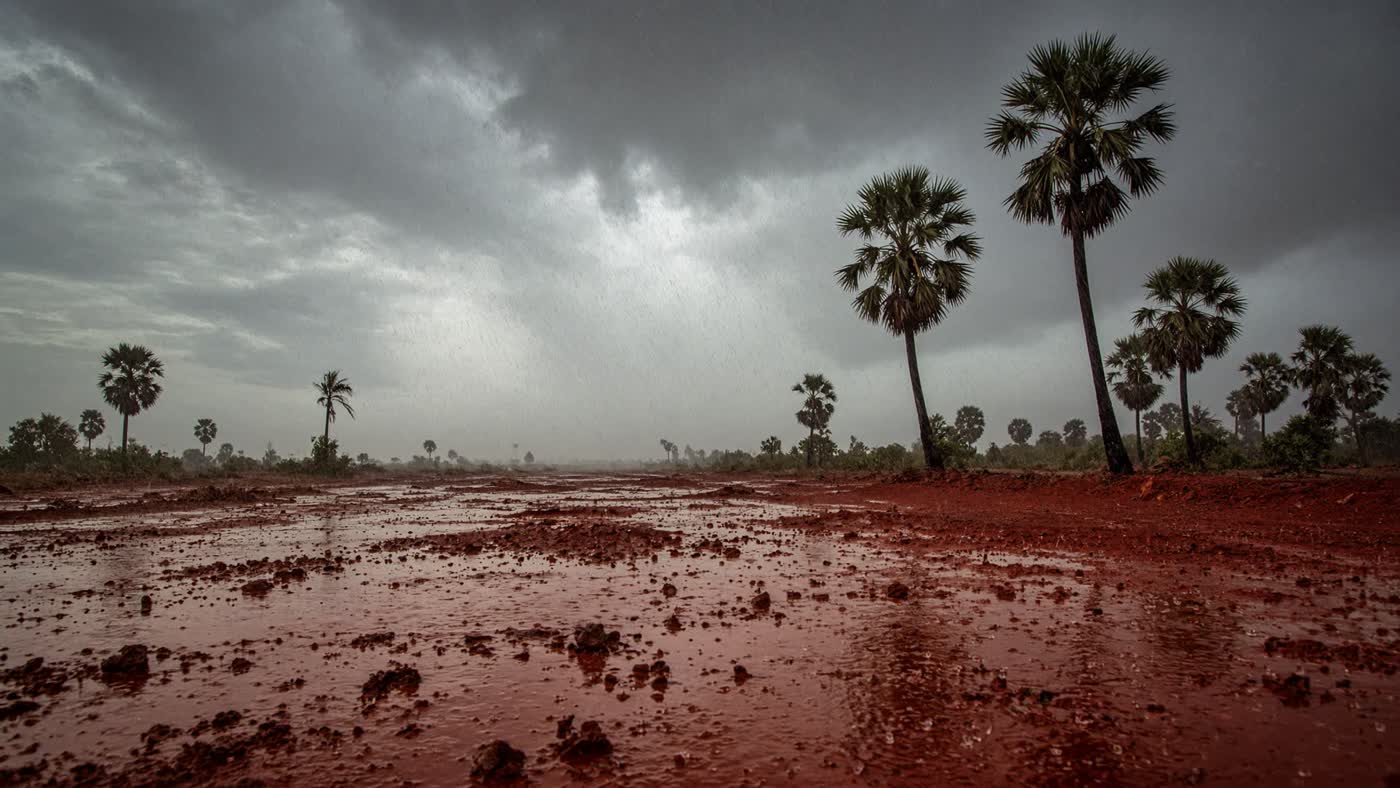
Like red earth and the rain that pours on it, she says, our hearts that hold love have mixed. The simile is famous because it refuses both ancestry and accident. Red soil takes water and becomes a third thing. The poem does not say that this mixing is ownership. It says that it has already happened.
Tinai is not decoration. In Sangam poetics a landscape is a whole climate of love: flower, bird, hour, season, and the particular danger of that hour. Kurinji is union in the hills. Mullai is waiting in the forest. Neytal is the seashore anxiety. This is not a world in which feeling is abstract and scenery is added later. The land is how the feeling is known.
Madurai is the traditional centre of the Sangam. The dates, often placed in the early centuries CE, are scholarly weather, not a birth certificate. What is not in doubt is the language. Tamil, here, is not a flavour. It is the mouth. Two voices, in this archive’s layout: the woman’s questions, and the rain that answers without becoming a man.
Two voices
Kapilar
யாயும் ஞாயும் யாரா கியரோ எந்தையும் நுந்தையும் எம்முறைக் கேளிர் யானும் நீயும் எவ்வழி யறிதும் செம்புலப் பெயனீர் போல அன்புடை நெஞ்சம் தாம் கலந்தனவே
Editorial paraphrase
Who was my mother to yours. What kin was my father to your father. By what road did you and I come to know each other. Like red earth and the rain that falls on it, the hearts that hold love have mixed.
The line that survived
Like red earth and the rain that falls on it, the hearts that hold love have mixed.
Editorial rendering of Kuruntokai 40’s closing simile.
Distant echoes
Another language
The Cloud MessengerRain as messenger, rain as mixing, a shared monsoon, two poetics.
Echo
When He Dances ElsewhereUnion and waiting as landscapes, not as psychology only.
Source / evidence
- Kuruntokai 40·Ettuttokai (Eight Anthologies), classical Tamil Sangam corpus. Attributed to Kapilar. Akam, commonly read in the kurinji tinai.
- On not flattening the corpus·Sangam poetics distinguishes akam and puram, and organizes love by tinai landscapes. This is Tamil literature, not an anonymous sample of ‘the East.’
The Tamil is ancient and public domain. English is a labeled editorial rendering, written to avoid copying modern copyrighted translations (including A. K. Ramanujan). No letters are invented.
One question remains
If two hearts mix like rain and red earth, what, if anything, is still owned?