
Jayadeva, Gīta Govinda · Sena-period Bengal
When He Dances Elsewhere
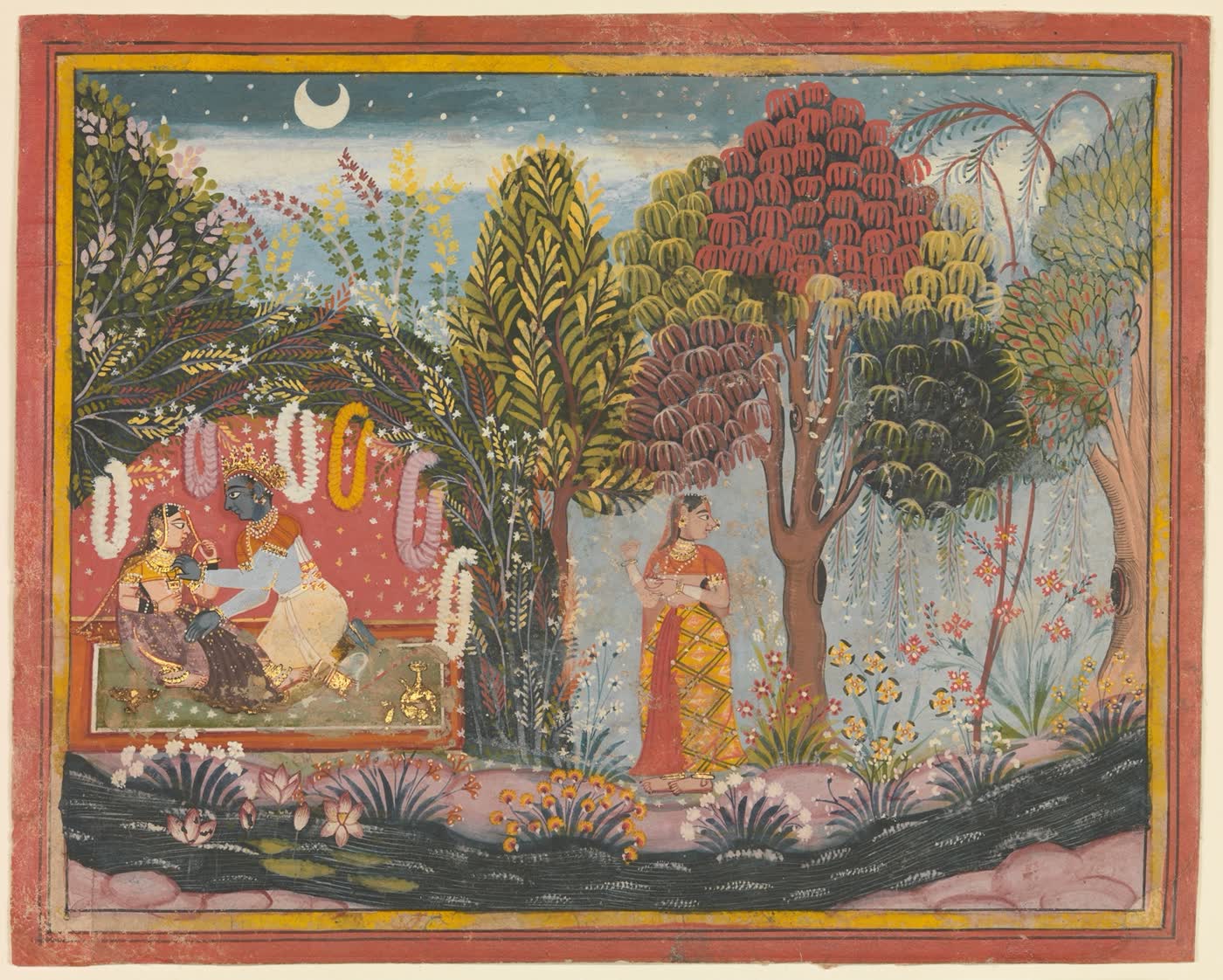
Jayadeva sings Rādhā’s waiting while Krishna stays among the gopīs. In this poem the sacred and the erotic refuse to be sorted. Viraha is not a plot delay. It is the devotion.
JayadevaRādhāKrishna (Govinda)
Bengal (with Puri tradition)
Jayadeva composed the Gīta Govinda in twelfth-century Bengal, in a Sanskritic world that also looked east to Puri and the cult of Jagannātha. The poem is twelve sargas of song, aṣṭapadīs meant to be sung, not merely read, in which Krishna, called Govinda, and Rādhā love, separate, accuse, and return. It is Vaishnava bhakti in a court metre. It is also a poem in which hips, night, and the flute are not metaphors waiting to be excused.
Viraha, love in separation, is the engine. Krishna stays among the other gopīs. Rādhā waits, then refuses, then burns. A friend goes between them like a camera. The forest is a set that keeps changing light. If this were only a romance, the delay would be cruelty dressed as plot. In the poem’s own terms the delay is the devotion: God tasted as absence, absence tasted as God.
Do not file it as Hindu Hallmark. The jealousy is real in the song. The erotic is not a veil over a Sunday lesson. Bhakti here is a practice of wanting that does not agree to be only polite. Kāma and viraha occupy the same stanza without asking which of them is the guest.
Edwin Arnold, in 1875, made a Victorian English that still has a right to be sampled because it is public domain, and a duty to be distrusted because it is Victorian: “The sky is clouded; and the wood resembles / The sky, thick-arched with black Tamála boughs.” The cloud, again. The wood as weather. Arnold called it an Indian Song of Songs, which is a comparison and a colonial habit. The comparison has a point. The habit does not get the last word.
Later painting, Kangra, the temple hangings, the modern calendar, would freeze particular gestures until they seemed inevitable. The poem is more restless than its stills. Rādhā is not a mascot of patience. She is a speaker of want, and the want is allowed to be angry. When he returns, the return is not proof that waiting is a woman’s job. It is a religious drama that has not yet been made safe.
The line that survived
The sky is clouded; and the wood resembles The sky, thick-arched with black Tamála boughs.
Sir Edwin Arnold, The Indian Song of Songs, 1875, opening. Public domain. A Victorian door into a Sanskrit night, not the night itself.
Interpretation
Religious-studies care means this: Krishna is God in the poem’s world, and Rādhā’s body is not a problem the poem is trying to solve. To un-eroticize it in the name of respect is another disrespect. To un-sacralize it in the name of modernity is a third.
Viraha is not an excuse for abandonment in a human household. The gopī’s waiting is a theology. It is a poor manual for a marriage.
Distant echoes
Echo
The Shepherd in the Dry SeasonSacred marriage and seasonal absence, without pretending Sumer and Bengal are one cult.
Across the table
Rise Up, My LoveCanon that kept the body inside the holy.
Source / evidence
- Jayadeva, Gīta Govinda·Twelve sargas of Sanskrit song, late 12th century, Bengal; strong later association with Puri and Jagannātha worship.
- Edwin Arnold, 1875·The Indian Song of Songs. Public domain; quoted in brief. Not a scholarly substitute for the Sanskrit.
- Sahibdin, Krishna and Radha in a Bower, ca. 1665·Page from a dispersed Gita Govinda. India (Rajasthan, Mewar). Gift of Ernest Erickson Foundation, 1988. Acc. 1988.103. The Metropolitan Museum of Art, Open Access. Later illustration of the poem, not a portrait of Jayadeva.
Jayadeva’s Sanskrit is historical. Sir Edwin Arnold’s 1875 English (The Indian Song of Songs) is public domain and is quoted briefly. Modern bhakti translations are not copied at length.
A word opens beside this story: kama
One question remains
If absence is how God is tasted, what happens to the one who is only a person, and waiting?