Chicksands Priory, 1652 to 1654
If you love me you will
From a former priory in Bedfordshire, Dorothy Osborne writes to a man the house does not want. The file that survives is almost only hers. The letter is how the days were spent.
Dorothy OsborneWilliam Temple
Chicksands Priory
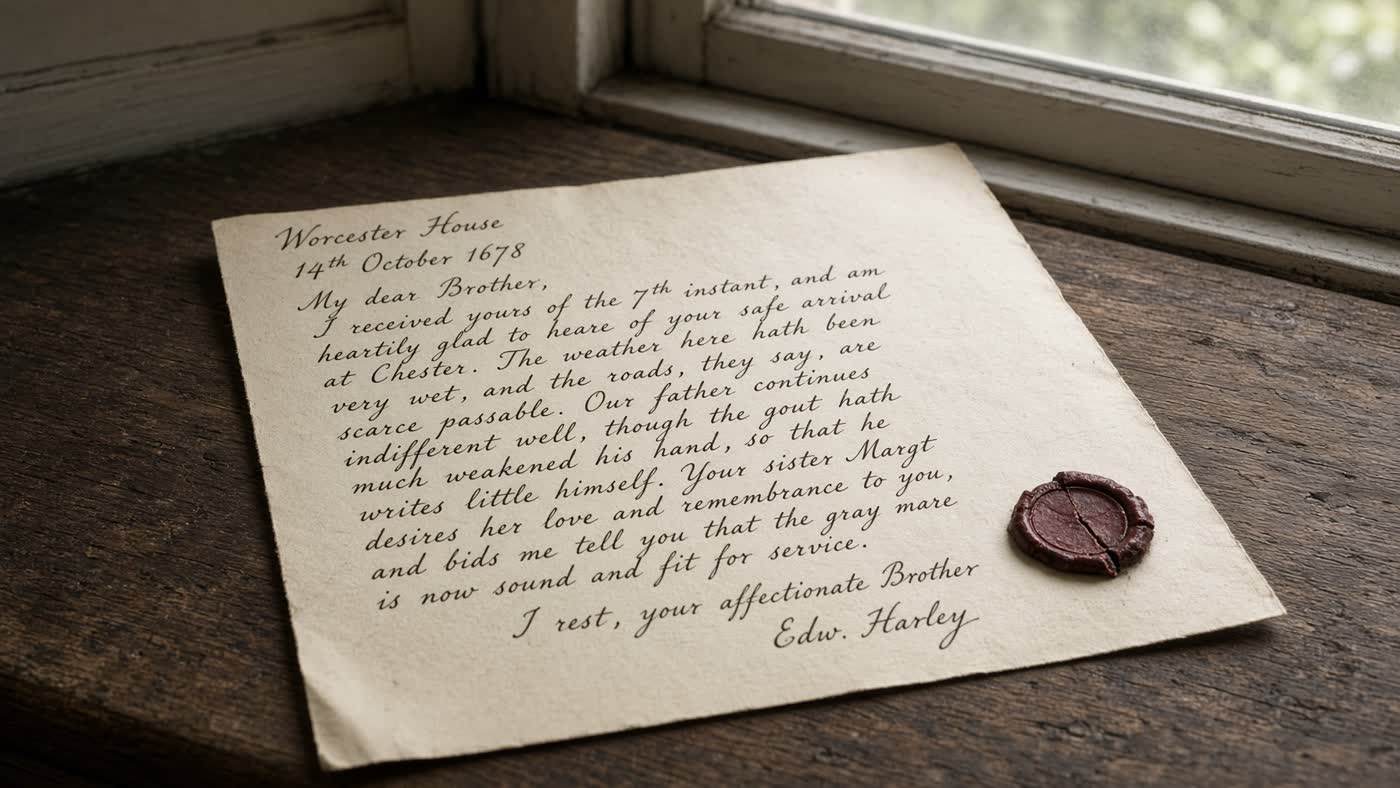
Chicksands Priory, Bedfordshire, 1653. A former nunnery, now the Osborne house. She is twenty-five, the youngest of the surviving children, and she is in the rooms with a father who is not going to get well. The man she writes to is not in the house.
They had already met. Later lives place the first meeting on the Isle of Wight, in 1647 or 1648, on a journey bound up with her father's holding of Guernsey for the King. Parry tells an inn, a window, an arrest. We do not have her own dated account of that day. The letters that survive do not begin there. They begin when Temple is back in England in 1652, and they run until two months before the marriage.
The family has other names. A cousin. Sir Justinian Isham, a learned widower she calls a coxcomb. Henry Cromwell, who once promised her an Irish greyhound. To her people Temple looks like an adventurer without fortune enough. What she can do, in a house that will not give her the match, is write.
The letter is not a metaphor. It is a wait. A carrier, sometimes a man called Harrold. A bag. A seal that once arrives already broken. She goes out to meet the fellow as she usually does. If the horses are served first, she is angry. If there is no letter, she invents accidents that have not happened. Duration, here, is a road and a bag.
One morning she tells him that her very dreams are his, then that she drinks his health in an infusion of steel that would poison a horse, and that at ten o'clock she is making her will. That is not yet a sentence for a card. It is a body in a room, taking a doctor's drench, thinking of a man the household has not accepted.
About seventy-seven of her English letters are counted in the catalogue most of this house used. The British Library volume is Add. MS 33975; some tallies of that volume run to seventy-nine. Almost none of his letters are in it. EMLO, following Parker, says she almost always destroyed his after reading. We cannot watch her do it. We can only read one consciousness, addressed toward another, and admit that the other page is not here.
The letter
Chicksands · Parry's Letter 10, grouped to 1653. No date on the sheet.
You ask my thoughts but at one hour; you will think me bountiful, I hope, when I shall tell you that I know no hour when you have them not. No, in earnest, my very dreams are yours, and I have got such a habit of thinking of you that any other thought intrudes and proves uneasy to me. I drink your health every morning in a drench that would poison a horse I believe, and 'tis the only way I have to persuade myself to take it. 'Tis the infusion of steel, and makes me so horridly sick, that every day at ten o'clock I am making my will and taking leave of all my friends. You will believe you are not forgot then.
Primary source · Dorothy Osborne to William Temple
Dorothy Osborne to William Temple, Parry's Letter 10, grouped to 1653
my very dreams are yours
What happened next
Sir Peter Osborne died in March 1654, after a long illness, and was buried at Campton. On the 18th she wrote a letter fully dated that day: Temple was no sooner gone than she lost the best father in the world. The burial had already happened. The eldest brother, she says in that same sheet, is publishing their story and tormenting her while they have both just lost a father. A later catalogue says Henry remained hostile after the wedding as well. Dorothy and William married at the end of 1654. Parry, following Courtenay, does not fix the day. Later catalogues say December. The later household at Sheen and Moor Park is another life. These pages keep the years when the letters were the courtship.
Distant echoes
Echo
Two LuxuriesAnother English file in which one voice has to carry the waiting.
Across the table
The Empty ThresholdA marriage written from one side, in which the day's rooms still count.
Source / evidence
- Dorothy Osborne to William Temple, letter printed as Letter 10·Edward Abbott Parry, ed., The Love Letters of Dorothy Osborne to Sir William Temple, 1652 to 1654 (New York: Dodd, Mead, 1901). Letter 10, no date on the sheet, printed under Life at Chicksands, 1653. The steel-drench paragraph. Project Gutenberg 12544.
- Dorothy Osborne to William Temple, letter printed as Letter 17·Same edition. Chapter III, Life at Chicksands, 1653. No date on the sheet. “Oh, if you do not send me long letters, then you are the cruellest person that can be! If you love me you will; and if you do not, I shall never love myself.”
- Dorothy Osborne to William Temple, letter printed as Letter 55·Same Parry edition. Fully dated 18 March 1654. Written after Sir Peter's burial at Campton. The eldest brother is already publishing the match.
- British Library, Add. MS 33975·The surviving English file from Osborne to Temple. EMLO counts about seventy-seven. Some catalogues of the same volume count seventy-nine. His replies are not in the volume.
- Early Modern Letters Online, Dorothy Osborne catalogue·Kenneth Parker, ed., Dorothy Osborne: Letters to Sir William Temple, 1652 to 1654 (Aldershot: Ashgate, 2002). EMLO notes the letters begin on Temple’s return to England in 1652 and end two months before the marriage, and that most of his letters do not survive, as she almost always destroyed them after reading.
Osborne died 1695. Parry's 1901 printing is public domain. The manuscripts are British Library Add. MS 33975. We do not invent Temple's missing side.
One question remains
If she burned his after reading, as the catalogue has it, what did she think she was keeping, and what did she refuse to keep?