Hampstead, then Rome · England and Rome, 1819 to 1821
Two Luxuries
John Keats writes to Fanny Brawne of her loveliness and of the hour of his death. The first is the love. The second is a fact he could not bargain with.
John KeatsFanny Brawne
Hampstead
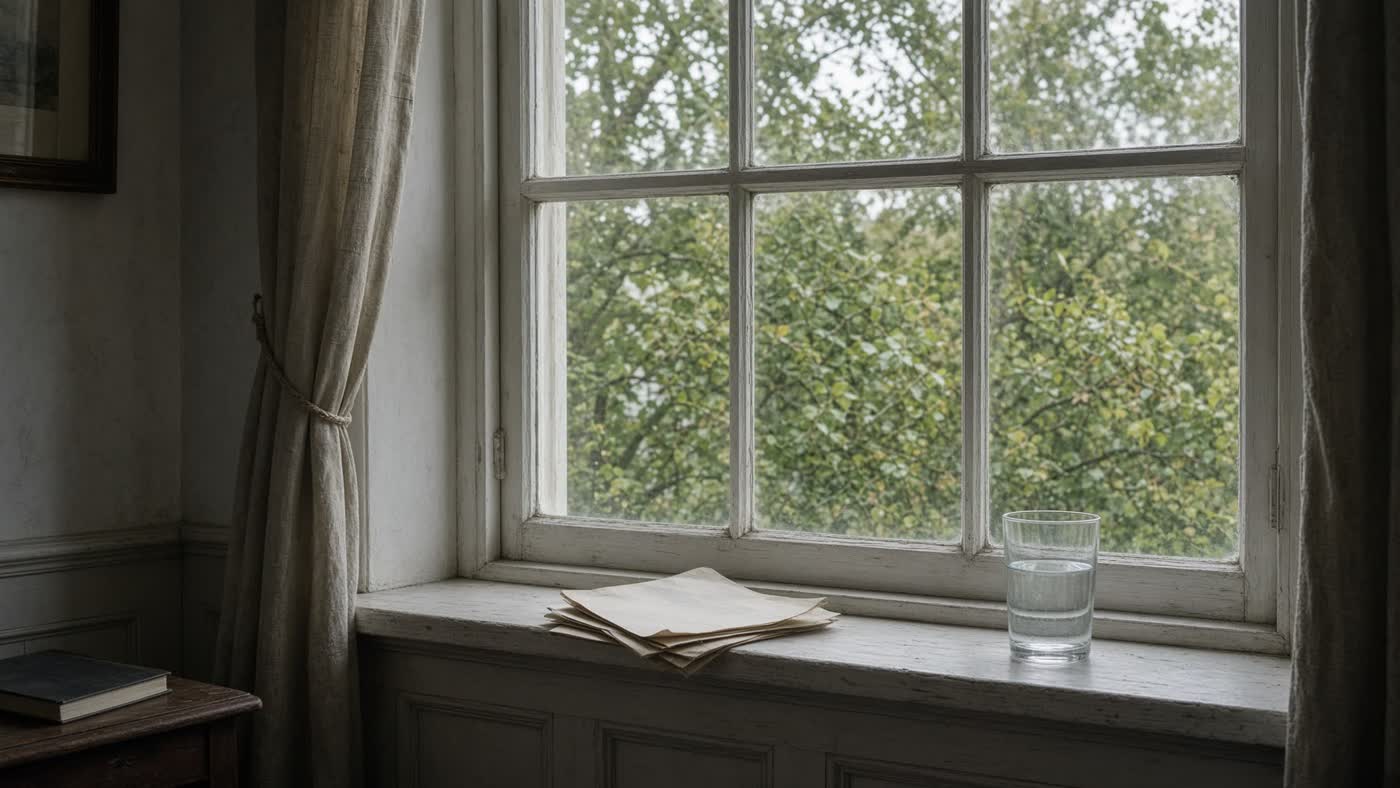
They lived as neighbors at Wentworth Place in Hampstead: he on one side of the house, she and her mother on the other. He had little money and a trade he had set down. She was young, clever, fond of fashion in a way his friends found easy to mock. The mockery is not evidence. He wrote to her as if attention itself were a form of keeping.
In July 1819, from the Isle of Wight, he sent a letter that has been asked to do too much work in the later cult of the beautiful dead. I have two luxuries to brood over in my walks, your Loveliness and the hour of my death. O that I could have possession of them both in the same minute. The sentence is his. What we do with it is ours. This office refuses to make the second luxury into the romance. Consumption is not a candle. Class is not a subplot. He was ill, and he was not rich enough to be a simple catch, and he loved her with a heat that frightened even him.
The letters of 1819 and 1820 are full of ordinary weather, walks, jealousy, a ring, the wish to be near without being watched. Intensity is not the same as wisdom. He could be demanding. She could be opaque. They were engaged. His friends disapproved. None of that is as famous as the death, which is a problem of fame, not of love.
He sailed for Italy in September 1820, hoping the air would do what England had not. Fanny did not go. He died in Rome on 23 February 1821, in rooms beside the Spanish Steps, with Joseph Severn. He was twenty-five. She was not in the room. That absence is not a failure of romance. It is how illness and money and family actually arranged the last months.
The letter
written from Shanklin; the life was Hampstead · 25 July 1819
My sweet Girl,
I have two luxuries to brood over in my walks, your Loveliness and the hour of my death. O that I could have possession of them both in the same minute.
Your's ever, fair Star, JOHN KEATS.
Primary source · John Keats to Fanny Brawne
Atlas plate · England and Rome, 1819 to 1821
Two Luxuries
He goes to Rome to die. She remains in Hampstead.
From one shore toward the other. A path of relation, not a lineage.
From
Between
Toward
- From
- Wentworth Place, Hampstead
- Toward
- Rome, where he is buried
- Between
- the Channel, France, the Alps, the last climate he was sent to seek
- Distance
- about 1,430 km from the house they shared to the grave she could not follow
- Obstacle
- consumption, money, a medical sentence
- Beloved
- Fanny Brawne
- Time apart
- his last months
- Message delay
- letters that arrive more slowly than a body fails
- What stands between them
- illness, and a path of relation that is not a shared journey
Keats to Fanny Brawne, 25 July 1819
I have two luxuries to brood over in my walks, your Loveliness and the hour of my death.
What happened next
Fanny kept his letters and his ring. She later married Louis Lindon and lived into her sixties. The letters were published in 1878, after both of them were gone, and the nineteenth century made a shrine of what had been a difficult, living attachment.
Keats is buried in the Protestant Cemetery in Rome. The famous epitaph, here lies one whose name was writ in water, is a bitterness about fame. It is not a theory of love.
Distant echoes
Counterpoint
If I Do Not ReturnAnother last season of letters. Neither death was a style.
Echo
Unsterbliche GeliebteWhat a letter can hold when the life will not.
Source / evidence
- Letters of John Keats to Fanny Brawne (1878)·Harry Buxton Forman edition from the manuscripts; public domain. The 25 July 1819 letter is among them.
- Wentworth Place, Hampstead·Now Keats House. The Brawnes occupied the other half of the house from 1818. The nearness is architectural, not metaphorical.
- Death in Rome, 23 February 1821·Piazza di Spagna; tuberculosis. Severn's letters describe the dying. They are evidence of illness, not an aesthetic.
Keats died 1821. The letters to Fanny Brawne, published 1878 from the manuscripts, are public domain. Short quotation only.
A word opens beside this story: eros
One question remains
If he had lived, would we still call the letters enough?