
Teplitz, unsent · Teplitz, July 1812
Unsterbliche Geliebte
In July 1812 Beethoven writes, in pencil, to a woman he calls immortal. The letter stays with him. Her name does not.
Ludwig van Beethoventhe Immortal Beloved
Teplitz (Teplice)
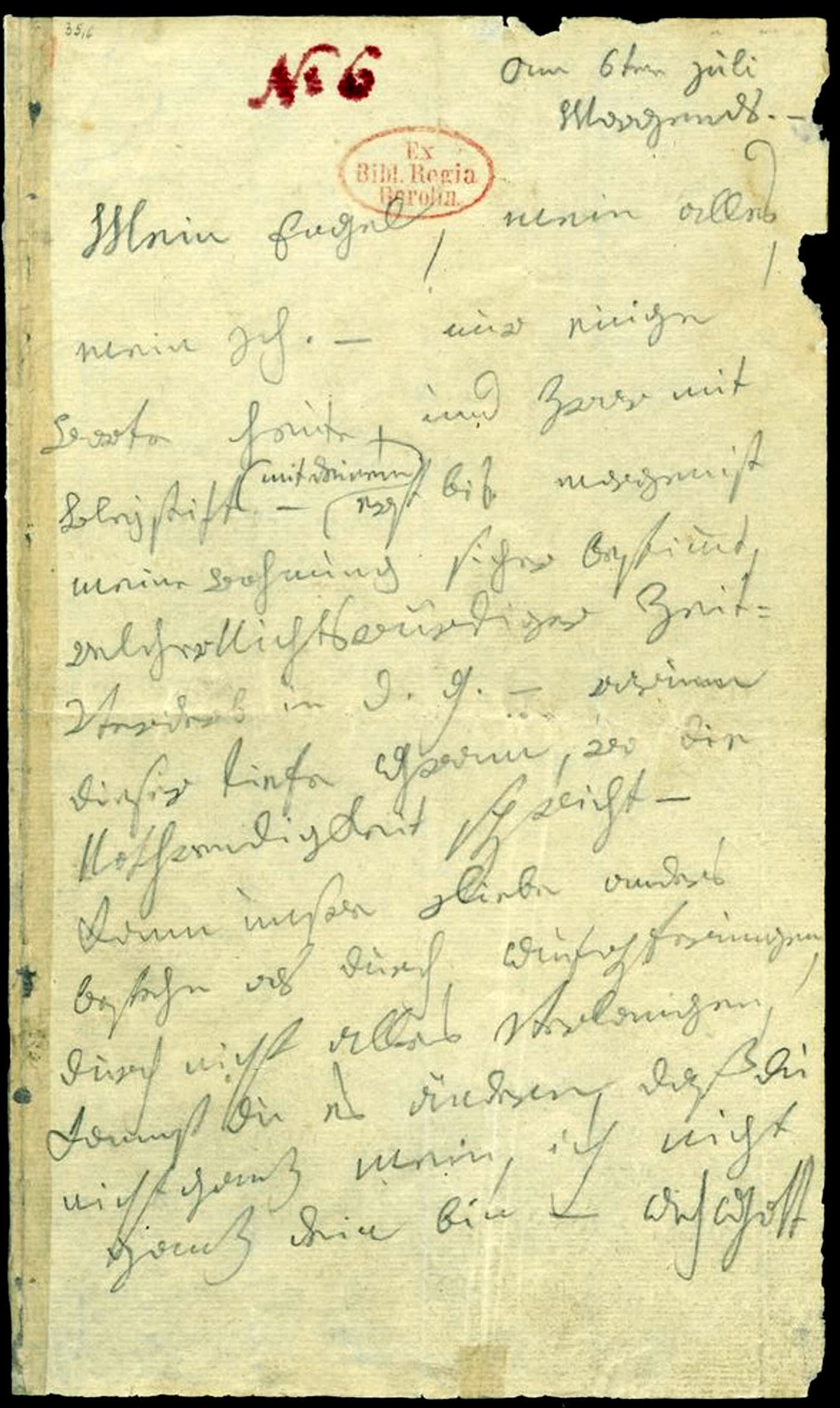
He wrote it in pencil, on ten small pages, at Teplitz, on the sixth and seventh of July 1812. He used du, the intimate you. He called her his angel, his all, his very self, and, in the morning of the seventh, his immortal beloved. Then the letter stayed. It was found in his estate after he died in 1827. It is now in the Berlin State Library.
Necessity, he says, speaks. Can our love endure except through sacrifices, except through not demanding everything? Can you change it that you are not wholly mine, I not wholly thine. The sentences push and double back. He wants all of her and argues, in the same breath, that all cannot be had. Love, in this handwriting, is a demand he cannot finish sending.
Who she was remains disputed. Antonie Brentano. Josephine Brunsvik. Other names have been walked through the watermarks, the almanacs, the guest lists of spa towns. Each candidacy has its scholars and its wreckage. This office does not solve it. A solved beloved would be a kind of possession the letter itself cannot enact.
The romance is not the mystery-novel of her identity. The romance is the page that never posted: a man in a rented room, half-deaf, writing toward a woman who would have had to live in a world that did not make a life with him simple, and then keeping the paper.
The letter
Teplitz · 6 July 1812, morning
Mein Engel, mein alles, mein Ich. …kannst du es ändern, daß du nicht ganz mein, ich nicht ganz dein bist.
Primary source · Ludwig van Beethoven
6 July 1812, morning
My angel, my all, my very self, only a few words to-day and at that with pencil (with yours), Why this deep sorrow where necessity speaks, can our love endure except through sacrifices, except through not demanding everything, can you change it that you are not wholly mine, I not wholly thine.
Translation · Alexander Wheelock Thayer (public domain) · Beethoven, Thayer's English
7 July 1812
Ever thine, ever mine, ever for each other.
Translation · Alexander Wheelock Thayer (public domain) · Beethoven, closing
Beethoven, close of the Immortal Beloved letter
ewig dein ewig mein ewig unß
What happened next
He did not marry her, whoever she was. He did not marry anyone. The letter remained among his papers, which is its own kind of sending: to time, not to a door.
Biography has spent two centuries trying to write an address on an envelope that never had one. The work is not nothing. It is also not the same as reading what he actually left.
Distant echoes
Echo
Two LuxuriesA walk in which the beloved and impossibility keep the same time.
Counterpoint
From the Italian CampaignAnother demand that the beloved be wholly his. Beethoven at least asks whether love can live without that demand. Napoleon does not.
Source / evidence
- Staatsbibliothek zu Berlin, autograph·Pencil letter of 6 to 7 July 1812, ten small pages, found in Beethoven's Nachlass. Watermarks later fixed the year and the spa. The frontispiece is a facsimile of page 1, with the Berlin library stamp.
- Alexander Wheelock Thayer, Life of Beethoven·Nineteenth-century biography and English rendering; public domain. Later scholarship (Brandenburg and others) refined dating without closing identity.
- On the candidates·Antonie Brentano and Josephine Brunsvik are the names most often argued. Others have been proposed. The identification is not settled. We do not pretend it is.
Beethoven died 1827. German text and Alexander Wheelock Thayer's 19th-century English are public domain. Short quotation; we do not reprint the letter entire.
A word opens beside this story: minne
One question remains
If a letter is never sent, has the beloved been spared, or only left outside the room?