
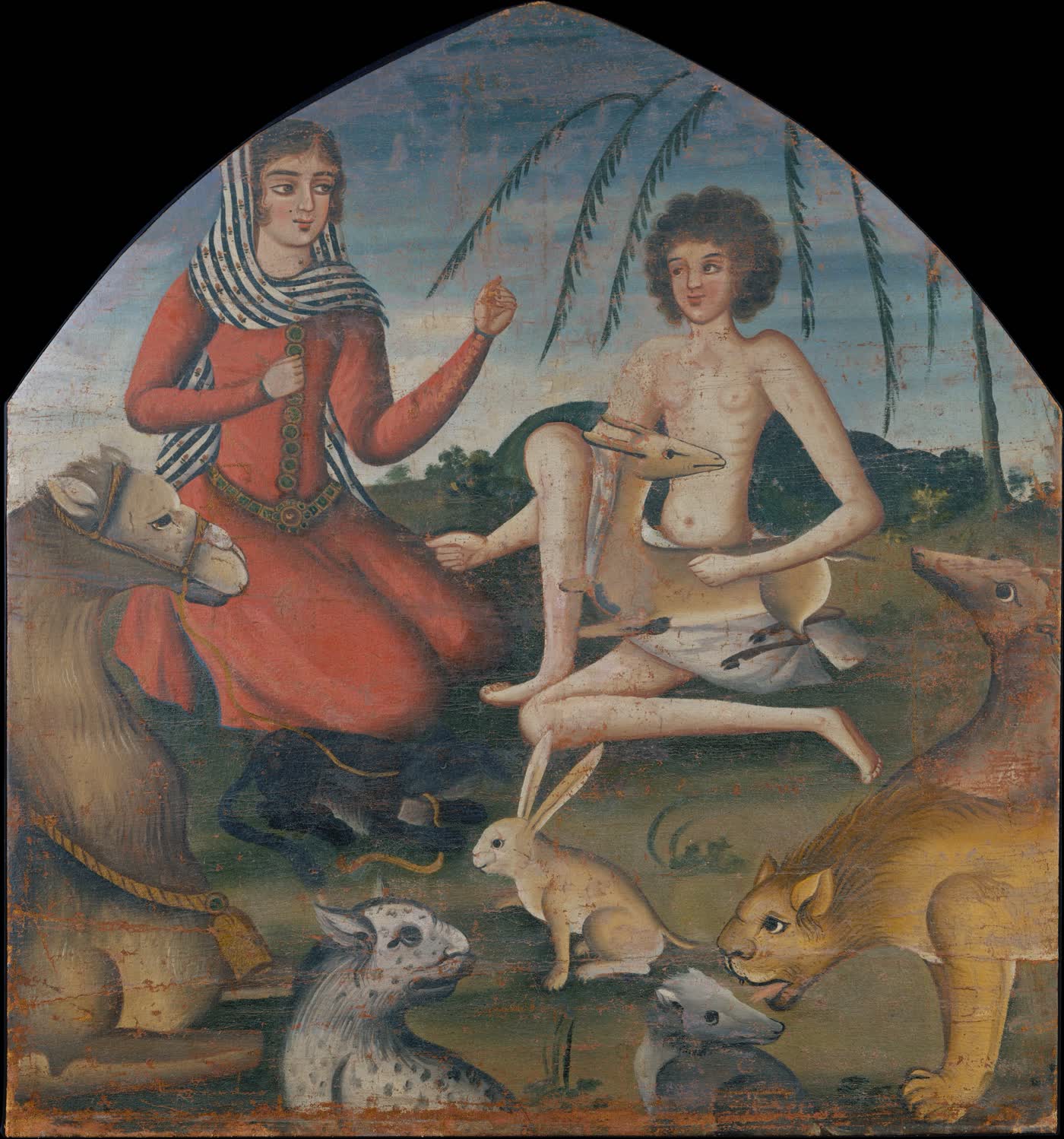
Nizami, Laylā and Majnūn, 1188 · Seljuk-period Caucasus
The Man Who Went to the Wilderness
At Ganja, Nizami took an Arab legend and made a Persian wound: Qays named mad for Laylā, then named by the desert. The poem loves its grief. It does not have to be a model.
Nizami GanjaviQays (Majnūn)Laylā
Ganja
In 1188, at Ganja, a city that is now in Azerbaijan, Nizami Ganjavi composed Laylā and Majnūn as one of the five treasures of his Khamsa. He took a legend already told in Arabic: Qays ibn al-Mulawwaḥ, a boy of the Banu ʿAmir, who loved Laylā, was refused the marriage, and went into the wilderness until people called him Majnūn, the possessed, the mad. Nizami made the wound Persian, courtly, and long enough to live in.
The families will not have the match. That refusal is social, not mystical. Qays’s poems make the love public; publicity makes it unmarriable. He leaves the tents. The desert becomes the only room that will have him. Animals keep him company because people will not. This is not yet a symbol. It is a man without a household.
Laylā is not a silent prize. In Nizami she speaks, marries another under pressure, and dies of a grief the poem does not treat as a pretty illness. Qays outlives her only long enough to die on her grave. The cinema of the story, night, sand, the name shouted into empty air, is easy to love. The ease is a danger. A poem can be magnificent about self-loss without self-loss becoming an instruction.
Later Sufi readings heard in Majnūn the lover of God, the ego stripped, the desert as tawḥīd. Those readings are old and they are interpretation. They are not the only truth of a masnavi that also knows tribal honour, a forced marriage, and a man who stops eating. To baptize the wilderness too quickly is to leave Laylā behind again, as if she were a ladder.
Do not glorify the destruction. Allow the poem its own wound. Nizami is a maker of beauty; beauty is not evidence that the love was wise, or that the families were right, or that madness is a rank in heaven. What survived is a name pair the world still uses when it wants to mean: this wanting did not get to become a house.
The line that survived
They called him Majnūn, not as a joke first, and not yet as a saint. As a fact: the one whom love had taken out of the tents.
Editorial English, naming the turn the poem is built on. Not a copied modern stanza.
What happened next
In the poem, both die. In the world after the poem, the names travel: into Ottoman retellings, into Urdu, into films that sometimes prefer the desert to Laylā’s voice. Sufi allegory remains a living reading. It remains a reading.
Interpretation
Unanswered love is a form, not a recommendation. Forbidden is a social verdict, not a spice. Grief, in Nizami, is allowed to finish people. That finishing is the tragedy. It is not a proof of depth that the rest of us should imitate.
If God is later found in the wilderness, that finding belongs to the readers who made it. Nizami’s first obligation is to a girl who was not given, and a boy who could not stay.
Distant echoes
Elsewhere, centuries later
The Cloud MessengerDistance as the whole vocation of a poem, cloud road, desert road.
Counterpoint
A Gossamer LifeUnanswered as a life inside a house, not only as a life thrown out of one.
Source / evidence
- Nizami Ganjavi, Laylā and Majnūn (1188)·Persian masnavi composed at Ganja, part of the Khamsa. Based on earlier Arabic legend of Qays and Laylā.
- James Atkinson, 1836·Lailí and Majnún, English verse, public domain. Not quoted at length here; available as a historical English door, not as Nizami.
- Laila and Majnun, mid-18th century·Oil on canvas. Bequest of Charles K. Wilkinson, 1986. Acc. 1987.355.1. The Metropolitan Museum of Art, Open Access. A later picture of the legend, not Nizami's 1188 page.
Nizami’s Persian is historical. James Atkinson’s 1836 English exists in the public domain but is not quoted at length here. Modern versions (Gelpke and after) are not copied. No letters are invented.
A word opens beside this story: ishq
One question remains
If the wilderness is what love made of him, what, in the poem, was still required of the living?