
First poem of the Shijing · Zhou China
Ospreys
Water, birds, a modest woman, longing. Later readers made a moral of proper marriage. The poem itself keeps fishing in the stream.
The modest young woman (yaotiao shunü)The noble man (junzi)
Yellow River basin
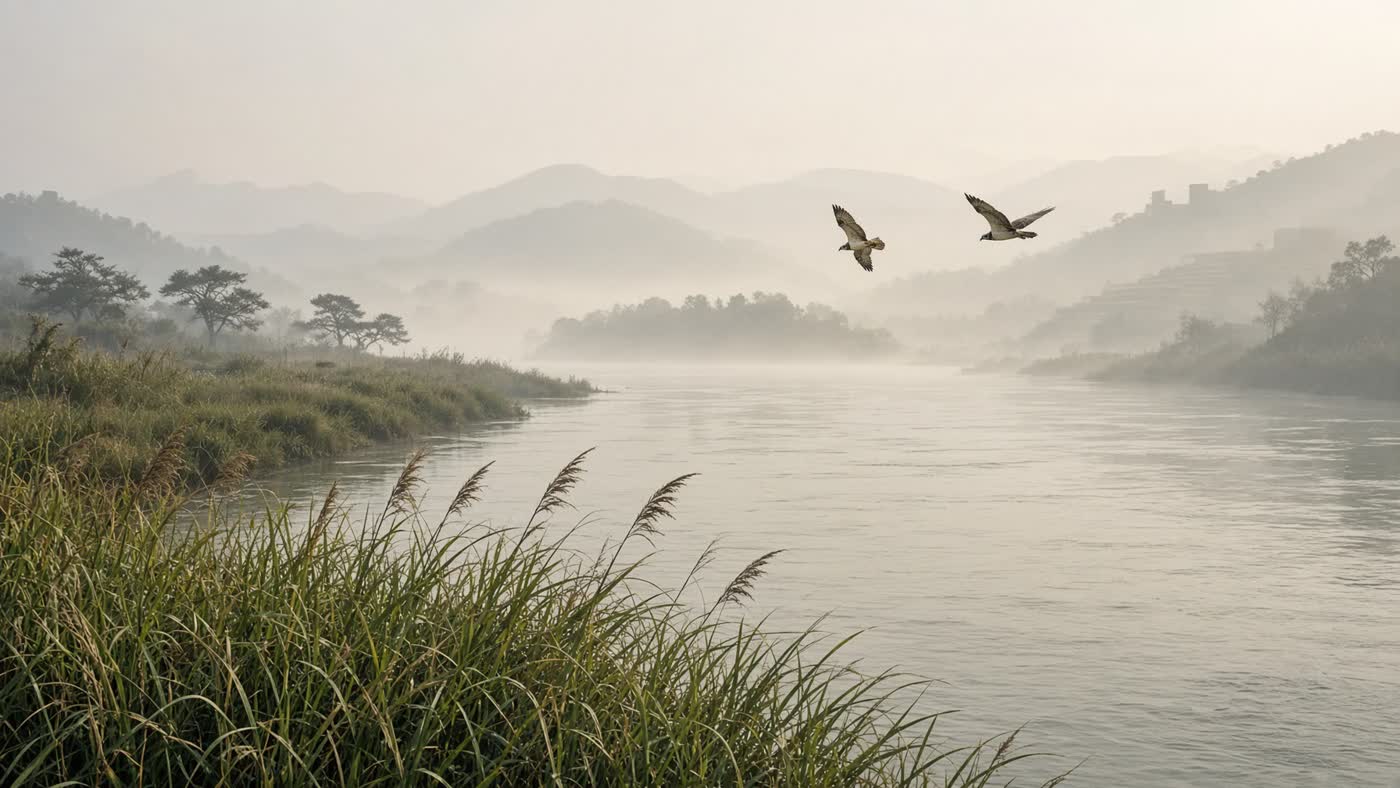
The Classic of Poetry opens with birds. Guan guan, the ospreys, or fish-hawks, ju jiu, on an islet in the river. Then a woman, yaotiao, modest, secluded, lovely in the old sense that does not yet mean decoration. Then a junzi, a noble man, and the word qiu: mate, match, the sought-for.
The rest of the short poem is waterwork. Uneven water-mallow, left and right we gather it, left and right we cook it. Waking, sleeping, he seeks her. He seeks and does not get her. He thinks of her, he tosses. The qin and se are brought out, the bells and drums. Courtship, in this telling, is harvest and insomnia and then music.
James Legge, in the nineteenth century, made English that still stands in the public domain: “Kwan-kwan go the ospreys, / On the islet in the river. / The modest, retiring, virtuous, young lady:, / For our prince a good mate she.” Virtuous is Legge’s pressure. The Chinese is quieter and stranger. Yaotiao is a way a person occupies space. Shu is a kind of goodness that is also refinement. The moral is not yet a sermon.
Later Confucian reading, the Mao preface and the commentarial centuries after, made Guan ju the image of proper beginning: a pair found without force, desire led into rite. That reading governed how the poem was taught. It is an interpretation, and a powerful one. It is not the only weather in the lines. Before the preface, there are birds on a sandbar and a man who cannot sleep.
Qing, the word this archive sets beside the poem, is not in the first stanza as a title. It is the later Chinese name for the whole weather: feeling, affection, the movement that makes a scene mean more than water. Guan ju became the doorway to a classic. Doorways accumulate fingerprints. The islet remains an islet.
The line that survived
Kwan-kwan go the ospreys, On the islet in the river. The modest, retiring, virtuous, young lady: , For our prince a good mate she.
James Legge, The She King, 1871, opening of Guan ju. Public domain. The word virtuous is the translator’s; the birds are the poem’s.
Interpretation
To read Guan ju only as a manual of correct marriage is to let the Han commentarial state finish the Zhou song. The poem can bear that reading. It can also bear a man awake at night and a woman who has not yet said yes.
Nothing here is a licence. Longing is not a right to the person on the islet. The music at the end is what the poem offers instead of seizure.
Distant echoes
Across the table
Rise Up, My LoveA canonical opening that never fully agrees to be only doctrine.
Another language
Red Earth and Pouring RainLandscape as the grammar of longing, river islet, red earth, without pretending the countries are one.
Source / evidence
- Shijing, “Guan ju” (Mao 1)·First poem of the Airs of the States, opening the Chinese Classic of Poetry. Chinese text public domain.
- James Legge, The She King·1871 English, public domain. Quoted in brief. Confucian prefaces are later frames, named here as interpretation.
The Chinese poem is ancient. James Legge’s nineteenth-century English is public domain and is quoted briefly. Later translations are not used at length.
A word opens beside this story: qing
One question remains
When the birds have done their calling, is the woman still a woman, or has she become a lesson?