Braintree to Philadelphia, 1776 · Massachusetts and Philadelphia
Remember the ladies
She wants a letter half as long as the ones she sends. The farm is hers. The children are still well. He is in Philadelphia. In the same sheet, later, she asks him to remember the ladies. The slogan is not the morning. The wait is.
Abigail AdamsJohn Adams
Braintree
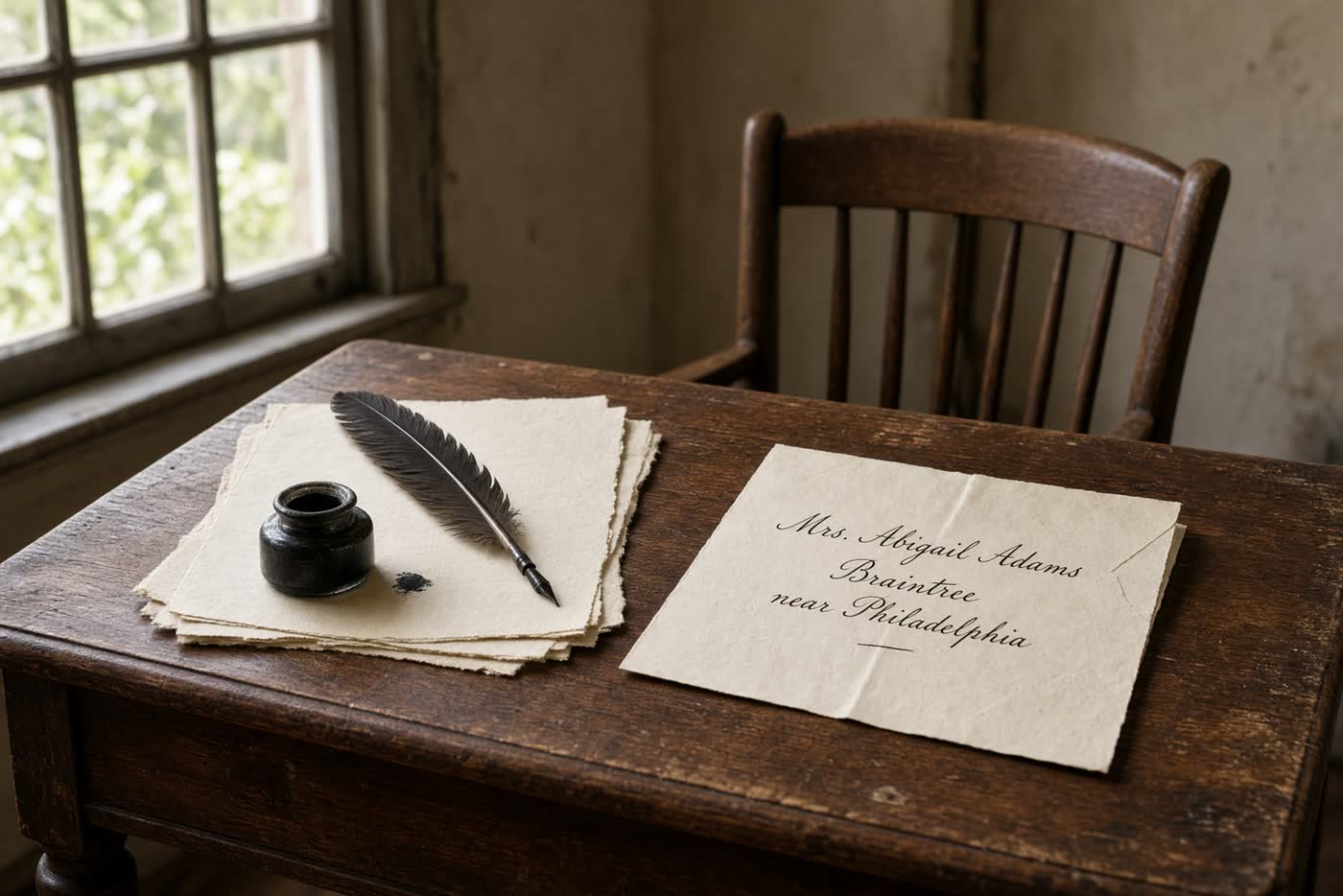
Braintree, 31 March 1776. Boston has been empty of the British for two weeks. She is thirty-one. The farm is hers to plant. He is in Philadelphia with the Congress. The last letter she has from him is dated 8 March. She opens this one by asking for a letter half as long as the ones she sends, and for news he may give: where the fleet has gone, what defence Virginia can make.
They had already been a marriage in the post for fourteen years. Courtship letters from 1762. The wedding in 1764. Four living children in the house this spring: Nabby, John Quincy, Charles, Thomas. She cannot go into Boston for fear of the smallpox. She sends Mr. Crane to look at their house there. A regimental doctor has been in it. It is very dirty. The few things left are gone. A month ago she could have seen it in flames. Now she wants the key, and the rooms shut.
She feels, she says, a gaieté de cœur to which she was a stranger. The sun looks brighter. They might sit under their own vine. Then the sheet waits five days for a carrier. 5 April. Neighbour Trot has lost two children in a week, George on Wednesday, Billy on Friday, the canker fever. Five grown people sick in this street. The mumps too. Isaac confined. Our own little flock are yet well. My Heart trembles with anxiety for them. God preserve them. She is making soap. She has not yet made saltpeter. She manufactures clothing or the family would be naked. The political sentence is in this same paper.
I long to hear that you have declared an independancy. And by the way, in the new Code of Laws, Remember the Ladies. Do not put unlimited power into the hands of the Husbands. If perticuliar care is not paid to the Laidies we are determined to foment a Rebelion. Those who wish to be happy give up Master for the more tender and endearing one of Friend. She signs, as she often does, Your ever faithfull Friend.
He answered on 14 April from Philadelphia. He could not but laugh. Another Tribe more numerous and powerfull. He would not repeal the Masculine systems. Rather the Despotism of the Peticoat. The house will not pretend the tease was a victory, or that the request remade the code. She did not drop the point. They kept writing for the rest of the life. The ladies were not remembered in the law as she had asked. The sheet remains the place where the asking can still be read.
The letter
Braintree · 31 March 1776
I wish you would ever write me a Letter half as long as I write you
I long to hear that you have declared an independancy—and by the way in the new Code of Laws which I suppose it will be necessary for you to make I desire you would Remember the Ladies, and be more generous and favourable to them than your ancestors. Do not put such unlimited power into the hands of the Husbands. Remember all Men would be tyrants if they could. If perticuliar care and attention is not paid to the Laidies we are determined to foment a Rebelion, and will not hold ourselves bound by any Laws in which we have no voice, or Representation.
Primary source · Abigail Adams to John Adams
Braintree · 31 March 1776
That your Sex are Naturally Tyrannical is a Truth so thoroughly established as to admit of no dispute, but such of you as wish to be happy willingly give up the harsh title of Master for the more tender and endearing one of Friend.
Adieu. I need not say how much I am Your ever faithfull Friend.
Primary source · Abigail Adams to John Adams, same letter
Philadelphia · 14 April 1776
As to your extraordinary Code of Laws, I cannot but laugh. We have been told that our Struggle has loosened the bands of Government every where. That Children and Apprentices were disobedient—that schools and Colledges were grown turbulent—that Indians slighted their Guardians and Negroes grew insolent to their Masters. But your Letter was the first Intimation that another Tribe more numerous and powerfull than all the rest were grown discontented. This is rather too coarse a Compliment but you are so saucy, I wont blot it out. Depend upon it, We know better than to repeal our Masculine systems.
Primary source · John Adams to Abigail Adams
Atlas plate · Massachusetts and Philadelphia
Remember the ladies
Braintree writes the farm and the law. Philadelphia is making a country.
From one shore toward the other. A path of relation, not a lineage.
From
Between
Toward
Placement is approximate where the record is not a surveyor.
- From
- Braintree, Massachusetts
- Toward
- Philadelphia, the Congress
- Between
- New England roads, a war, the post
- Distance
- about 440 km of a country that does not yet exist on paper
- Obstacle
- war, office, the length of a sitting
- Beloved
- John Adams
- Time apart
- the months of 1776, and many years of the same road
- Message delay
- a rider, a packet, a letter half as long as she asked
- What stands between them
- a farm and a congress, and a sentence about the ladies
Abigail Adams to John Adams, 31 March 1776
the more tender and endearing one of Friend
What happened next
She wrote again on 7 May and did not drop the point. He did not put the ladies into the code. They kept the post until 1818. About eleven hundred of their letters survive. This house does not count that as a happy ending to the request. It counts it as the file.
Distant echoes
Echo
If you love me you willAnother wait in which the letter is how the days were spent, and the famous sentence is not the first room.
Source / evidence
- Abigail Adams to John Adams, 31 March–5 April 1776, Founders Online / Massachusetts Historical Society·Adams Papers. Public domain. Spelling of the hand retained. The sheet is one letter, held five days for a carrier, with the 5 April addition from the sick street.
- John Adams to Abigail Adams, 14 April 1776, Founders Online·The petticoat reply. Public domain.
- Abigail Adams to John Adams, 7 May 1776, Founders Online·She does not drop the point. Not quoted at length here.
Abigail Adams died 1818. John Adams died 1826. Founders Online / Massachusetts Historical Society texts are public domain. Spelling follows her hand: Laidies, Rebelion, perticuliar, independancy.
A word opens beside this story: philia
One question remains
What did Friend mean, in that English, that Master could not?