
Kimberley, January 1898 · Kimberley, 1897 to 1898
Special Licence
Solomon Tshekisho Plaatje, Motswana, courts Elizabeth M'belle, Mfengu, in a diamond town that does not make mixed families easy. They marry by special licence. The letters of the rocky courtship we paraphrase; the marriage we can date.
Solomon Tshekisho PlaatjeElizabeth Nomthetho M'belle
Kimberley
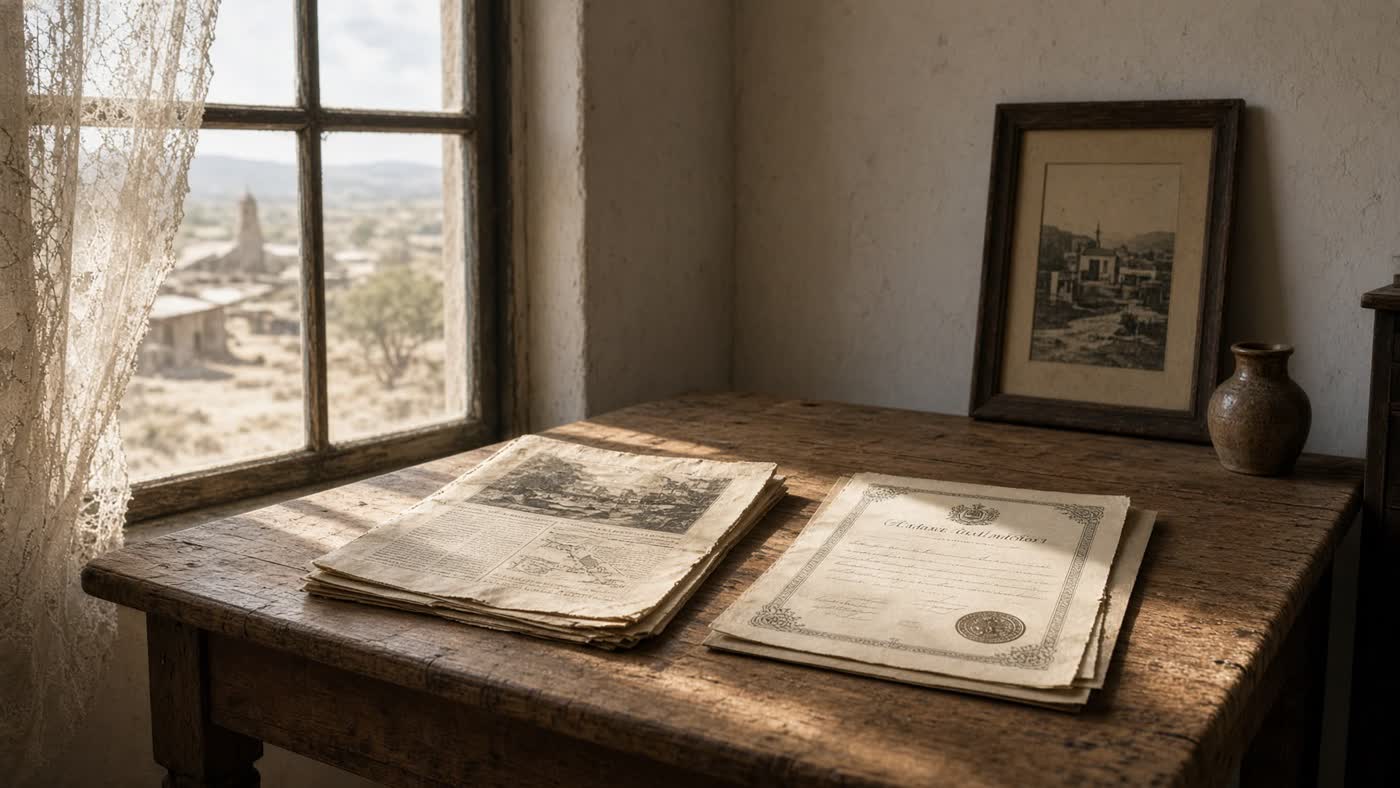
Kimberley at the end of the century was a grid of money and dust, a place where languages met because the mines required them to. Solomon Tshekisho Plaatje, Motswana, young, already collecting tongues, worked as a postman and then as a clerk and interpreter. Elizabeth Nomthetho M'belle, Mfengu, was a teacher, sister of a colleague. They courted. Both families objected.
He would later joke, in a line often repeated, that his people disliked a daughter-in-law whose language had clicks, and hers disliked a son-in-law whose language had none. Whether or not that sentence is quoted from a copyrighted gathering, the fact it points to is not in dispute: this was not a marriage the elders had arranged to keep a world sealed. It was a crossing, and it was rocky, and they did it anyway.
On 25 January 1898 they married by civil licence in Kimberley, a special licence, and then by a Congregational rite conducted by Reverend Davidson Msikinya. Paper first, then blessing. In a colony that was already inventing new cages for African life, a licence could be a small architecture of freedom. It could also be a door into years of political weather they could not yet see.
We do not reprint the courtship letters. Modern scholarly editions own those pages. What can be said without them: they wrote; they argued with kin; they chose each other across a linguistic border that relatives had charged with meaning. Mutuality here is not a sonnet. It is a licence dated in a diamond town.
The letter
Kimberley · courtship, Kimberley, 1890s
The surviving courtship is described by biographers as rocky: family resistance on both sides, a Motswana man, an Mfengu woman, a town watching. We will not ventriloquize their pages. The public fact is the licence of 25 January 1898, and the long marriage that followed it.
Editorial paraphrase · editorial paraphrase; modern letter editions not quoted
civil record; Kimberley
Married by special licence, Kimberley, 25 January 1898.
What happened next
That same year Plaatje went to Mafikeng as court interpreter. The siege of 1899 to 1900 would make him a diarist of war. Elizabeth kept house and children through the years in which he became a newspaper man, a founder of the South African Native National Congress, and the author of Native Life in South Africa (1916), written after the Natives Land Act had begun to unhouse a people.
The marriage lasted. The country did not become kinder. Love, in this story, is not a shelter from history. It is a way two people stayed in history together.
Distant echoes
Echo
Let Me Count the WaysCourtship against a family's will; paper as the way through.
Source / evidence
- Marriage, 25 January 1898, Kimberley·Civil (special) licence, followed by a religious ceremony under Rev. Davidson Msikinya of the Congregational Church. Date and form are in the local historical record.
- On the “rocky” courtship·Family opposition on ethnic and linguistic grounds is attested in biographical work. Modern editions of the letters are copyrighted; we paraphrase only.
- Native Life in South Africa (1916)·Public domain. Later political prose, not a source of courtship quotation. It shows the world the marriage had to live in after the Land Act.
Modern editions of Plaatje's letters are copyrighted. We paraphrase the courtship and do not quote those editions. Native Life in South Africa (1916) is public domain and is used only as later context, not as a quarry for love-letter text.
A word opens beside this story: amor
One question remains
What does a marriage licence know about love that the families did not want to know?