
Wimpole Street, then Italy · London, 1845 to 1846
Let Me Count the Ways
Elizabeth Barrett and Robert Browning court by letter: invalid room, poet's visit, a father who would not bless them. The sonnet that survived is not a greeting card. It is a record of mutual attention.
Elizabeth BarrettRobert Browning
50 Wimpole Street
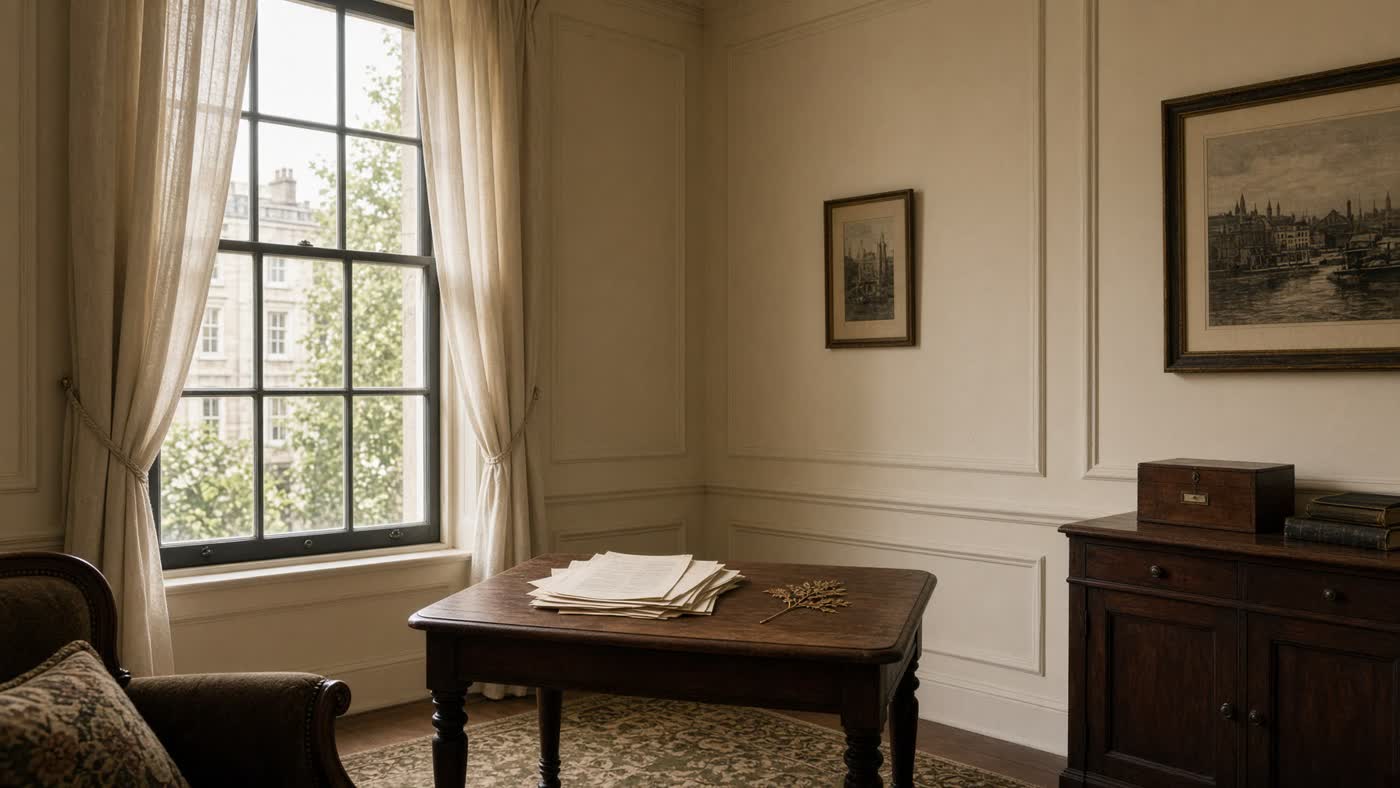
She was an invalid on Wimpole Street, famous already, kept in a room her father's will had furnished with duty. He, Robert Browning, wrote to her first on 10 January 1845 because he had read the poems. I love your verses with all my heart, dear Miss Barrett. Then, in the same letter: I love you too. It is a startling second sentence. She answered as a poet answers: with thanks, with precision, with the slow permission of someone who has had to ration her life.
They wrote for months before he was allowed up the stairs. The correspondence is not ornamental. They argue lines, Greek, the ethics of a visit. When he comes, the house watches. Edward Moulton-Barrett would not have consented to a marriage. In September 1846 they married at St Marylebone in a small privacy and left for the Continent. Italy was not a honeymoon postcard. It was air, work, a child later, a table at which two writers could sit without asking a father's leave.
During the courtship she wrote the sequence published in 1850 as Sonnets from the Portuguese, Portuguese because that was his name for her, not because the poems are translations. Sonnet 43 is the one fame kept. How do I love thee? Let me count the ways. Schoolrooms have worn the first line smooth. The poem itself is stranger: it counts by depth, by right, by necessity, by the old griefs, and then it risks the sentence after death. Mutuality is the point. She is not a muse. He is not a rescue. They chose each other in sentences before they chose each other in a church.
Two voices
Elizabeth Barrett
I love your verses with all my heart, dear Miss Barrett, and this is no off-hand complimentary letter that I shall write… I do, as I say, love these books with all my heart, and I love you too.
Elizabeth Barrett
I thank you, dear Mr. Browning, from the bottom of my heart… Sympathy is dear, very dear to me: but the sympathy of a poet, and of such a poet, is the quintessence of sympathy to me!
Elizabeth Barrett
How do I love thee? Let me count the ways. I love thee to the depth and breadth and height My soul can reach, when feeling out of sight For the ends of being and ideal grace. … I shall but love thee better after death.
The line that survived
How do I love thee? Let me count the ways.
Sonnets from the Portuguese, 43
What happened next
They lived and wrote in Italy. She died in Florence in 1861. He lived until 1889, editing, remembering, not replacing her in the easy way the century liked to imagine widowers did.
The sonnet outlived the letters in popular memory, which is a pity only if we forget that the letters are where the counting began: two minds, one closed house, a daily practice of attention.
Distant echoes
Counterpoint
From the Italian CampaignLetters of marriage, one pair counting, the other commanding.
Across the table
Special LicenceAnother courtship that had to argue with families before it could stand at a licence office.
Source / evidence
- The Letters of Robert Browning and Elizabeth Barrett Barrett, 1845 to 1846 (1899)·The courtship correspondence; public domain. First letter dated 10 January 1845.
- Sonnets from the Portuguese (1850)·Forty-four sonnets. Number 43 is public domain and widely reprinted; we quote only the famous opening and the last turn.
- Wimpole Street and the elopement of September 1846·Marriage at St Marylebone; departure for the Continent. Edward Barrett's opposition is documented in the family record and in the letters themselves.
Sonnets from the Portuguese (1850) and the Barrett to Browning courtship letters (published 1899) are public domain in the United States. Short quotation only.
A word opens beside this story: amor
One question remains
What is counted, when love is counted, feeling, or the days someone came up the stairs?