Suzhou, a marriage kept in ink · Qing China, late 18th century
Six Records
A failed clerk and a woman who arranged flowers write an ordinary Chinese marriage: jokes, pawned hairpins, shared moonlight, and the days after she is gone. Two of the six records are lost.
Shen FuChen Yun
SuzhouYangzhou
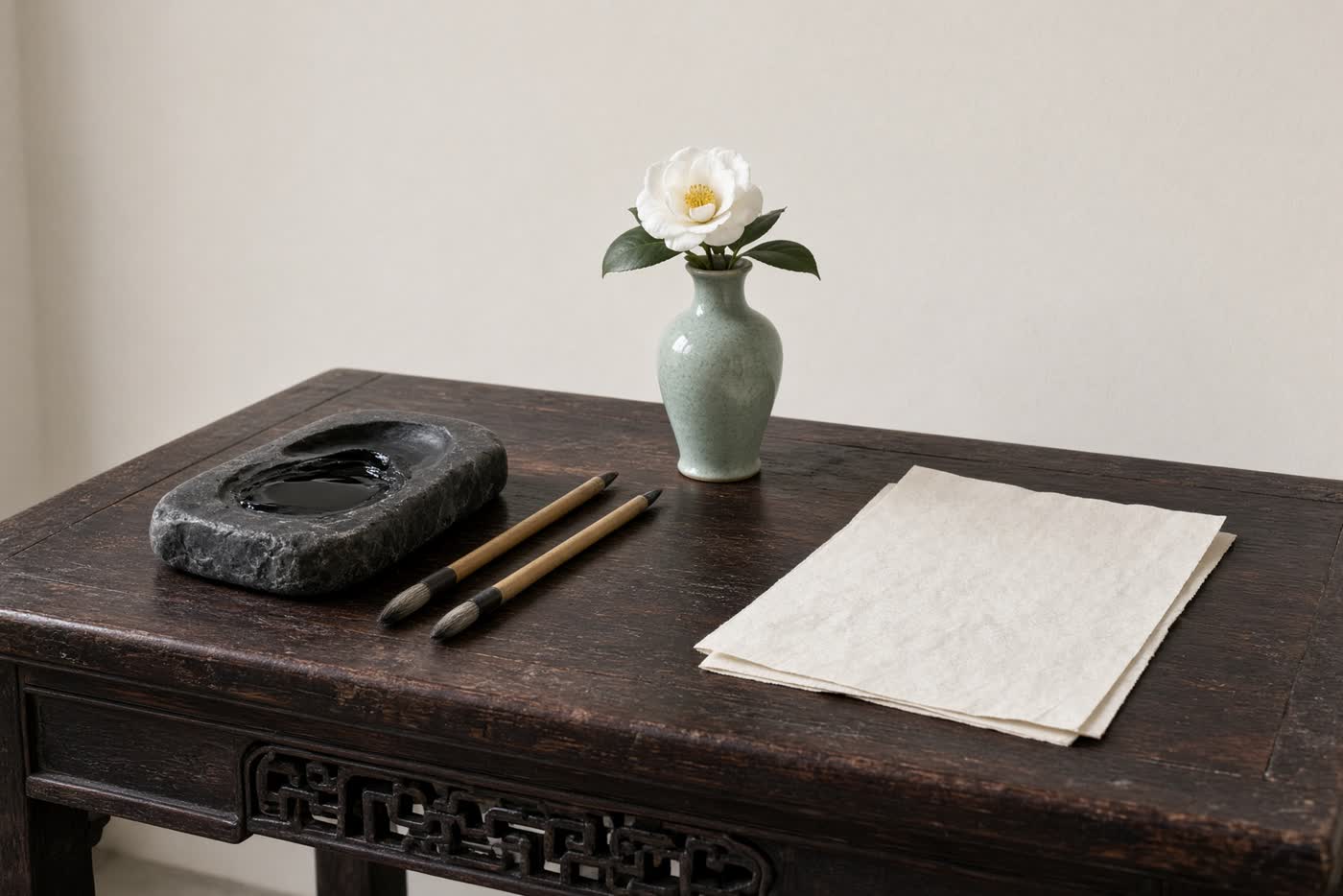
They married young in Suzhou. He was a secretary who did not rise. She arranged flowers, pawned a hairpin when the house was empty of coin, and sat with him over melon seeds. The book he later wrote is not a novel of rescue. It is a clerk's memory of a marriage that had jokes in it.
浮生六记, Six Records of a Floating Life. The title already knows the Buddhist proverb: a life is a bubble, a shadow. Four chapters survive: wedded bliss, the pleasures of leisure, the sorrows of misfortune, the delights of roaming. Two are lost. We do not invent them. Yun dies in 1803, of illness and of a household that had run out of room for her. The records do not ask the reader to call that a moral.
English readers often meet this book through Lin Yutang, who loved its lightness. That love is editorial. The Chinese is drier, funnier, and more exact about money. This house will not dusk the ordinary. They ate. They looked at the same moon. He wrote it down afterward, which is another kind of remaining.
The letter
余笑谓芸曰:卿非解人。
余笑谓芸曰:卿非解人。
Primary source · Shen Fu, Six Records of a Floating Life
I laughed and said to Yun: you are not the one who fails to understand.
Editorial paraphrase · house paraphrase, not Lin Yutang · Editorial paraphrase of Shen Fu addressing Yun
The world is wide, and still everyone looks up at the same moon.
Editorial paraphrase · house paraphrase · Editorial paraphrase of a shared-moon passage
Atlas plate · Qing China, late 18th century
Six Records
A failed clerk and a woman who arranged flowers write an ordinary Chinese marriage: jokes, pawned hairpins, shared moonlight, and the days after she is gone. Two of the six records are lost.
From one shore toward the other. A path of relation, not a lineage.
From
Between
Toward
Placement is approximate where the record is not a surveyor.
- From
- Yangzhou, Jiangsu
- Toward
- Suzhou, Jiangsu
- Distance
- 165 km
The line that survived
卿非解人
Shen Fu to Chen Yun, Six Records
What happened next
Yun died in 1803. Shen Fu kept writing. The last two records, of his later wandering and of a life after her, are the ones that did not survive. What remains is the marriage, and the fact of having written it.
Distant echoes
Echo
The Empty ThresholdAnother marriage written from one side, in which the day's rooms still count.
Source / evidence
- Shen Fu, Fusheng liuji (Six Records of a Floating Life)·Chinese public domain. Four chapters extant. English versions by Lin Yutang (1936), Shirley M. Black (1960), Pratt and Chiang (1983), and Graham Sanders (2011) are later and remain in copyright. Quoted here in Chinese, with house paraphrase labeled as such.
Shen Fu died about 1825. The Chinese text is public domain. Lin Yutang (1936) and later English versions remain in copyright. This house quotes Chinese and a labeled editorial paraphrase, not a modern translator's sentences.
A word opens beside this story: qing
One question remains
What would the two lost records have done to the marriage we think we already know?