A Washington horsecar, 1865 · Washington, from 1865
Dear Pete
Walt Whitman meets Peter Doyle, a horsecar conductor, on a stormy night. The letters that follow are companionship: working-class, queer, daily, and not a secret the poems had failed to tell.
Walt WhitmanPeter Doyle
Washington
Washington, 1865. Whitman was in his forties, a former army-hospital visitor still wearing the war in his body. Peter Doyle was a young Irish-born Confederate veteran who drove a horsecar. They met on a stormy night, Doyle would later say, when Whitman was the only passenger. Familiar at once. A hand. A looking. The city was full of men who had learned how to sit close in wartime and had not all gone home.
The letters that survive are not a closet drama. They are weather, money, health, jobs, the wish to share a room if one of them is ill. Dear Pete, dear son, my darling boy. Whitman's endearments run through kinship words because those were the words he had for keeping. Doyle writes back from the car-barn world: shifts, coughs, the ordinary. This is a working-class companionship. It is also queer. Those facts do not take turns.
In August 1869 Whitman wrote from Brooklyn after a bad night between them, a night by a fountain, a talk that had frightened him. The letter repairs. It sends money. It says the love is indestructible. We need not make a spectacle of the fright to believe the repair. The point is that they had a life in which a quarrel could be written down and survived.
Leaves of Grass had already invented a public language for adhesiveness. Doyle is not an illustration of the poems. He is a particular man with a conductor's hands who outlived Whitman and kept a coat.
Two voices
Walt Whitman
My love for you is indestructible, and since that night and morning has returned more than before. Dear Pete, dear son, my darling boy…
Peter Doyle
Doyle told Bucke they met on a stormy night in a Washington horsecar, Whitman the only passenger, looking like a sea captain under a blanket. They were familiar at once. The printed recollection is a workingman's voice, not a poet's preface.
The line that survived
My love for you is indestructible
Whitman to Doyle, 21 August 1869
What happened next
After Whitman's stroke in 1873 he lived in Camden. The letters continue, thinner with distance and health. Doyle visited. He was at the funeral in 1892.
In 1897 Richard Maurice Bucke published the correspondence as Calamus, with Doyle's memories. The title borrows Whitman's cluster of poems. The letters themselves are plainer, which is their dignity.
Distant echoes
Echo
A Hedge AwayPaper as the daily body of a love without a legal name.
Counterpoint
CrypthandAnother queer nineteenth century: one coded in a Yorkshire estate, one spoken on a Washington car.
Source / evidence
- Calamus: A Series of Letters Written during the Years 1868 to 1880 by Walt Whitman to a Young Friend (Peter Doyle), ed. R. M. Bucke (1897)·Public domain. Includes Doyle's account of the meeting and the texts of surviving letters.
- Walt Whitman Archive·Manuscripts and transcriptions of the Doyle correspondence, including the 21 August 1869 letter.
- Meeting, 1865·The horsecar meeting is Doyle's later testimony, not a diary entry from the night itself. We present it as recollection.
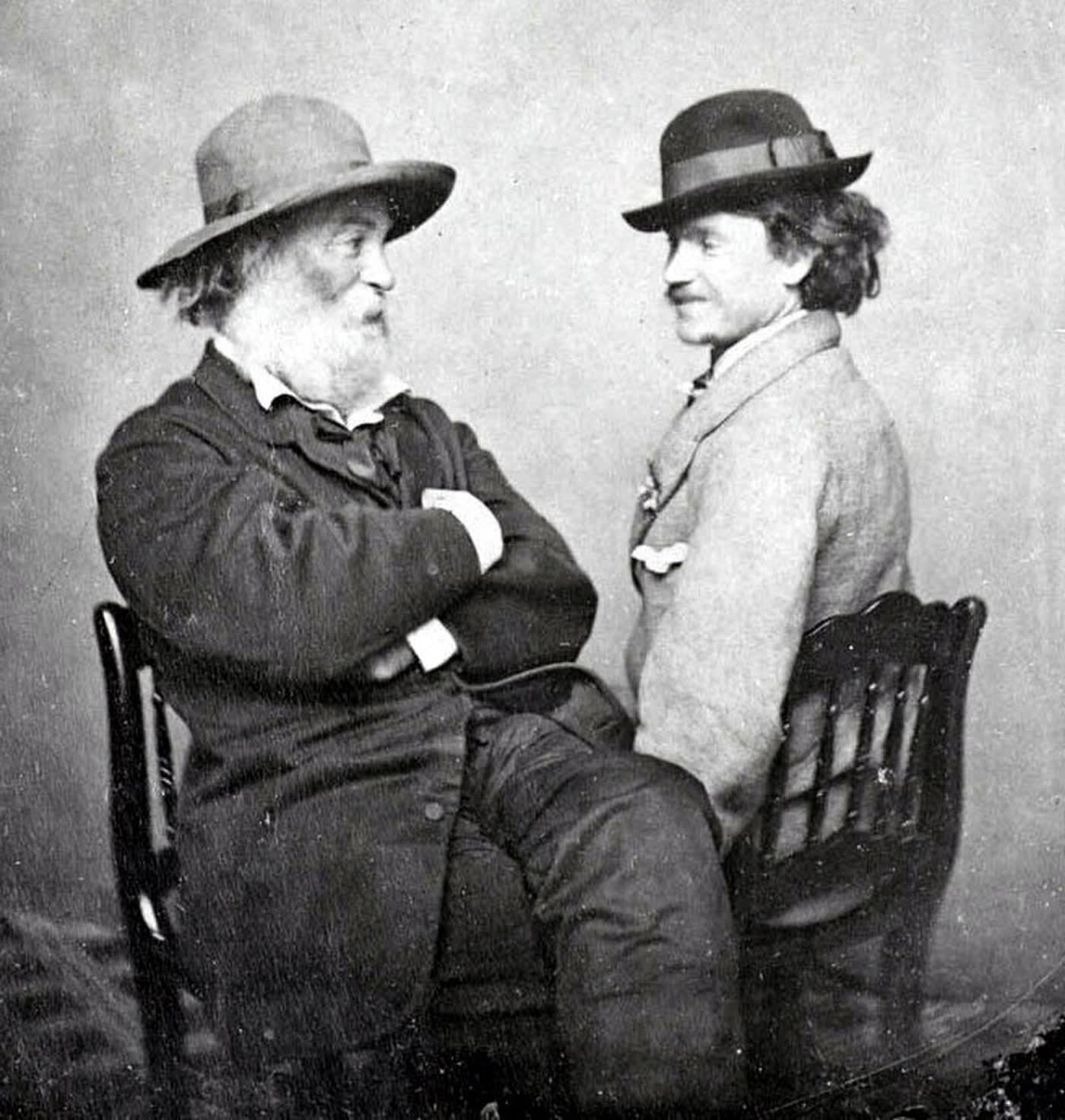
- Moses P. Rice, photograph of Whitman and Doyle, ca. 1869·Studio portrait, public domain. The two men looking at each other. The frontispiece is this photograph, not an illustration of the horsecar.
Whitman died 1892. Calamus: A Series of Letters… to a Young Friend (Peter Doyle), ed. R. M. Bucke, 1897, is public domain. Short quotation only.
A word opens beside this story: philia
One question remains
What if the most radical thing in these letters is not the desire, but the dailiness?