Lyon · 1555 · Lyon, French Renaissance
Kiss Me Again
Œuvres de Louïze Labé Lionnoize: sonnets, including “Baise m’encor.” The mouth on the page is certain. Whether one woman of Lyon wrote it is a living scholarly question. The poems survive either way.
Louise Labé
Lyon
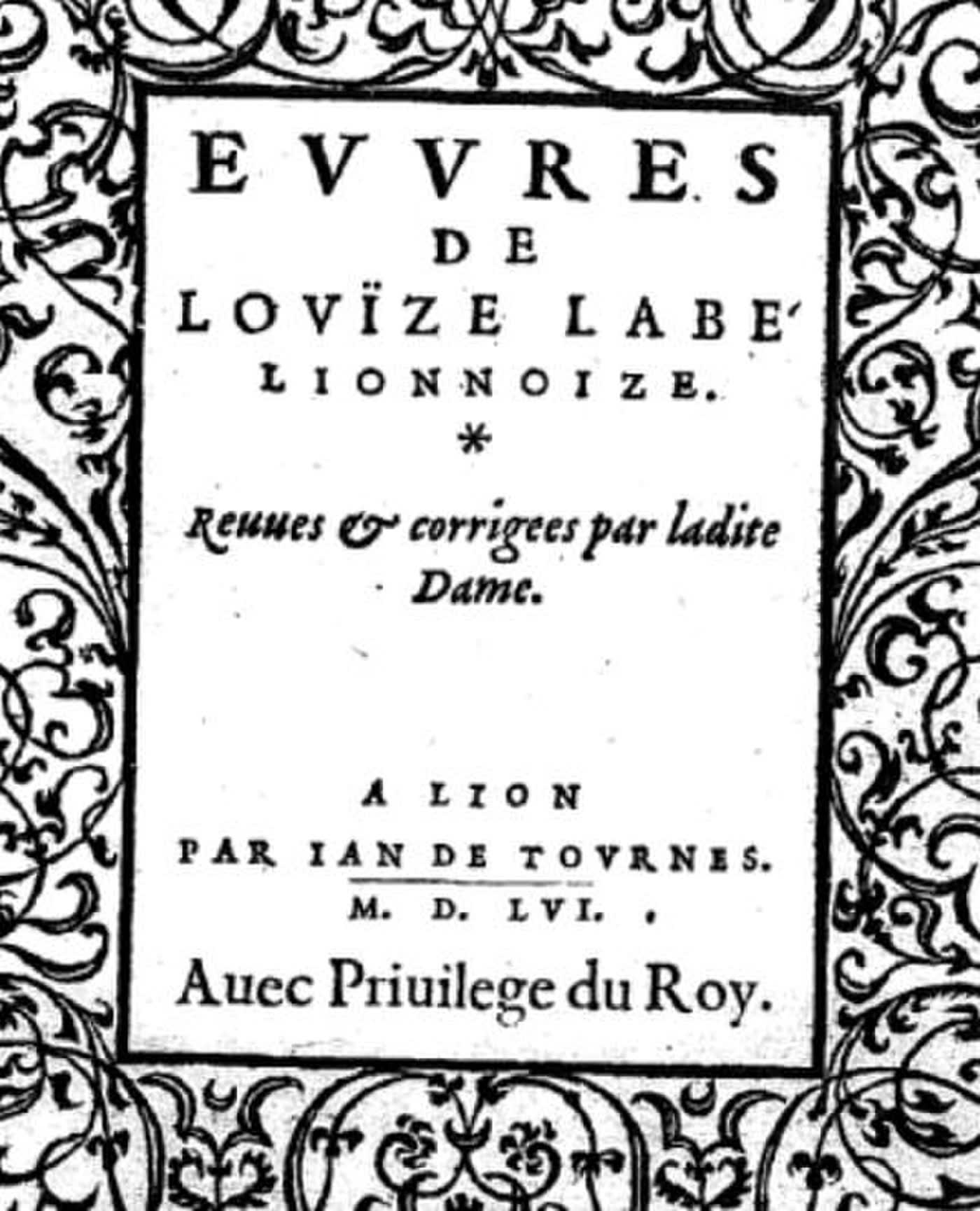
In 1555, Jean de Tournes printed in Lyon a small book: Œuvres de Louïze Labé Lionnoize. A dedicatory epistle to Clémence de Bourges. A Débat de Folie et d’Amour. Three elegies. Twenty-four sonnets. One of them begins as if the mouth had no time for Petrarch’s distance: Baise m’encor, rebaise moy et baise.
Kiss me again, kiss me, kiss. Give me one of your most savoury, one of your most amorous; I will give you four hotter than coal. The sonnet is not a hint. It is appetite written in decasyllables, then a turn into the old fear that desire will unmake the mind. Renaissance Lyon could print this under a woman’s name. That fact is already history.
There was a woman in Lyon, Louise Charly, called Labé, married to a ropemaker, la Belle Cordière in later anecdote. There was a salon, a circle of men who wrote. In 2006 the scholar Mireille Huchon argued that “Louise Labé” was a creature of paper, a collective male invention. Other scholars have answered that a woman wrote, or that the book is a mixed performance. The debate is not settled. This office will not pretend it is.
What the debate must not be allowed to do is kill the poems. If a circle of men wrote a woman’s hunger as a game, that is a fact about power and print. If a woman wrote it, that is a fact about a mouth in Lyon. Either way the sonnet is in the world, teaching later readers that a kiss can be a meter.
Rose, here, is not Valentine. It is the dust of a page that has been desired for too many centuries to be only a biographical puzzle. Read the French aloud. The scholarly question can sit in the margin without being asked to silence the middle of the room.
The line that survived
Baise m’encor, rebaise moy et baise: / Donne m’en un de tes plus savoureus, / Donne m’en un de tes plus amoureus: / Je t’en rendray quatre plus chaus que braise.
Louise Labé, Sonnet XVIII, Œuvres (Lyon, 1555)
Interpretation
A copyright and scholarly office can hold two cautions at once: do not launder a possibly male coterie into a feminist certainty; do not use uncertainty as a way to take kisses out of women’s mouths.
The poems remain. Biography, if it narrows, can still leave the type standing.
Distant echoes
Echo
MyongwolAnother sixteenth-century page where a woman’s desire is the craft, not the scandal’s illustration.
Source / evidence
- Œuvres de Louïze Labé Lionnoize, Lyon, Jean de Tournes, 1555·Public-domain French text of the sonnets, elegies, and debate. The frontispiece is the 1556 title page, not a recovered likeness.
- Authorship debate·Mireille Huchon, Louise Labé, une créature de papier (2006), and the answering scholarship. Mentioned as a question, not as a verdict that deletes the poems.

The 1555 Lyon Œuvres are public domain. Short French is quoted from that text. English is a labeled office rendering, not a copyrighted modern translation.
A word opens beside this story: eros
One question remains
If the name on the book is a question, do the kisses still have a mouth?