
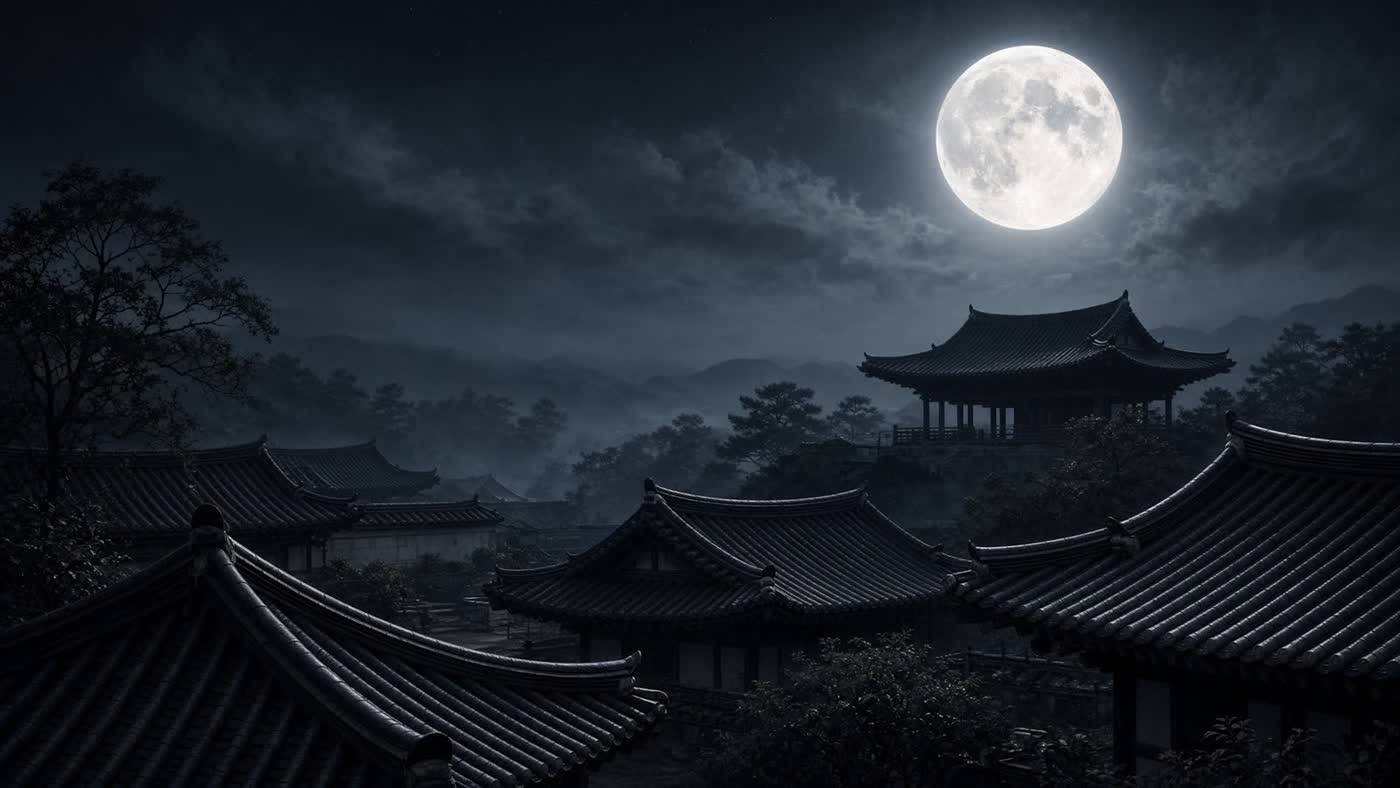
Songdo · sixteenth century · Joseon Korea
Myongwol
Hwang Jini, the gisaeng-poet called Bright Moon, wrote sijo with independence, wit, and desire. She was not waiting to be saved, and she is not a tragic courtesan cliché.
Hwang Jini (Myongwol)
Songdo (Kaesong)
Songdo, Kaesong, in the sixteenth century was a city of old Koryŏ memory inside a Joseon present. Hwang Jini, registered as a gisaeng, took the name Myongwol, Bright Moon. Gisaeng were trained in verse, music, conversation; they were not wives, and they were not free in any simple sense. Inside that constraint she became famous for a mind that would not perform gratitude on cue.
The sijo corpus attached to her is small, and some attributions are later habit. What the tradition insists on is a voice that cuts. One poem addresses a yangban whose name puns as Blue Stream: do not boast of your swift run through green mountains; the sea will take you; the bright moon fills the empty hills, why not rest? It is a refusal dressed as hospitality. She will not be rushed, bought, or carried away by a man’s current.
Another sijo, the one that survives in every anthology, takes the long midwinter night and treats it as a thing that can be cut, rolled, stored under a spring-wind quilt, and unrolled on the night the beloved returns. Desire here is practical, almost domestic, and completely unashamed. She does not die of the night. She keeps it.
Later centuries made her a tragic courtesan: the beautiful professional who loved once and was ruined. That cliché is a failure of reading. The poems that remain are not pleas to be taken off the register. They are wit, appetite, and a woman’s management of time. Independence, in a gisaeng’s world, is never absolute. It can still be a style of attention.
Do not save her. Do not pity her into a novel. Light a candle if you like; she already knew what to do with a long night.
The line that survived
I will cut the waist of this long midwinter night, roll it up, tuck it under a spring-wind quilt, and unroll it the night my love returns.
Editorial rendering of the famous sijo associated with Hwang Jini, not a copyrighted translation
Interpretation
A gender historian will note that gisaeng have been overwritten as both national allegories and erotic furniture. Hwang Jini’s remaining poems are narrower and sharper than either use.
Wit is a form of freedom that does not require us to pretend the institution was kind.
Distant echoes
Echo
Kiss Me AgainAnother sixteenth-century woman’s page on which desire is not apologetic, and on which later scholars argue about the name.
Source / evidence
- Sijo attributed to Hwang Jini·Joseon-era Korean verse, public domain. Attribution of individual poems is sometimes traditional rather than documentary.
- Editorial renderings·English here is the office’s short paraphrase of well-known sijo, labeled as such because modern literary translations remain in copyright.
Sixteenth-century sijo associated with Hwang Jini are public domain in Korean. Many English translations are copyrighted; this page uses labeled editorial renderings, not a living translator’s lines.
A word opens beside this story: qing
One question remains
What if the woman who can leave the night in a drawer is the one who was never only a story about staying?