Lhasa · 1683 to 1706
The Songs Below the Palace
Tsangyang Gyatso, the Sixth Dalai Lama, wrote songs of lovers and willow groves while holding a religious office. The tension is real. The later death is political and grim. It is not a lyric.
Tsangyang Gyatso
Lhasa
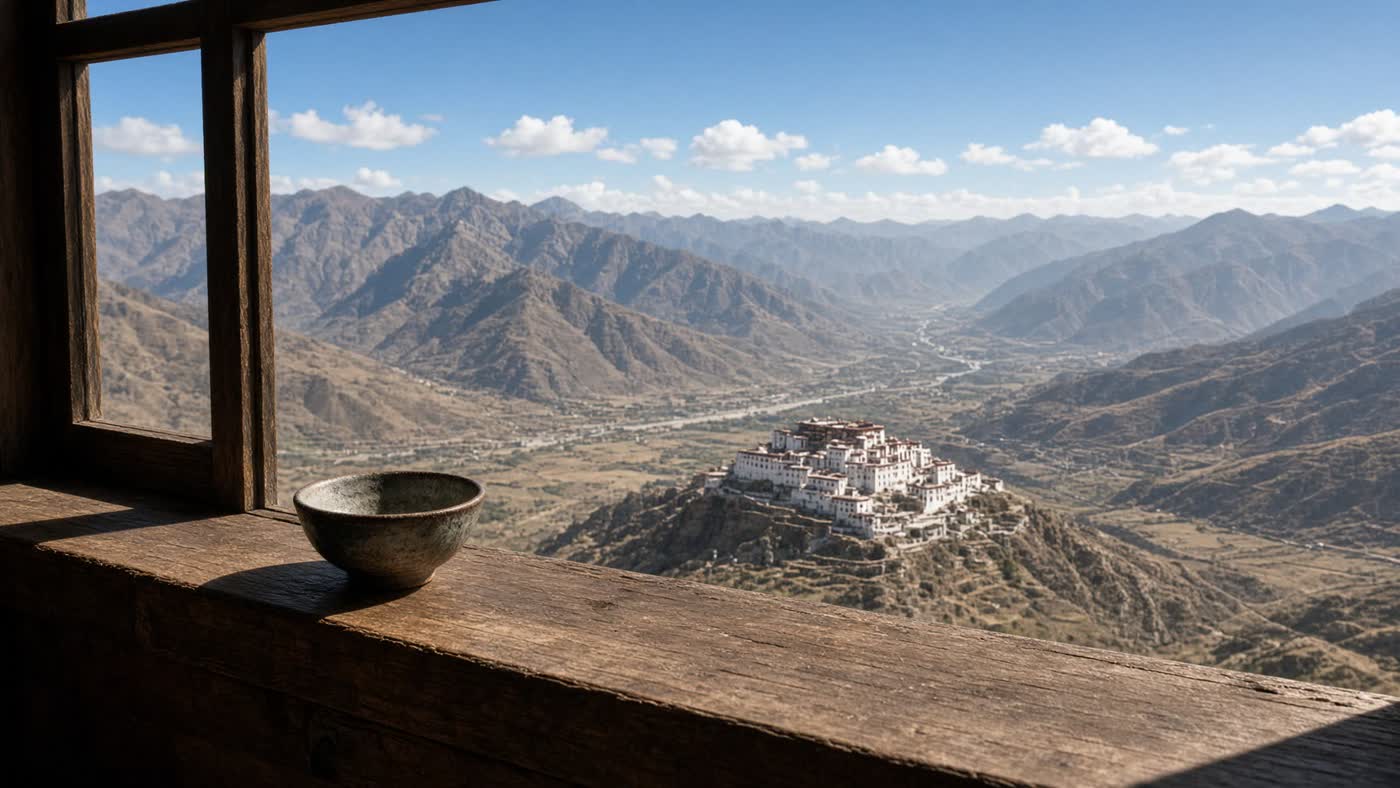
He was found as a reincarnation, raised toward an office that is not a metaphor, and enthroned as the Sixth Dalai Lama. Tsangyang Gyatso did not complete the monk’s full vows in the way the Geluk establishment required. He went down from the Potala into the town of Shol. He wrote songs.
The songs are short. They are not a diary we possess as dated entries, and this page will not invent one. They are mgur and glu, verse that later readers, with varying care, have called Tibetan love songs. Girls in willow groves. A body that will not pretend the yellow robe is the only garment. A split name: in the palace, the knowledge-holder Tsangyang Gyatso; below, in Shol, a wild man of another name. Every English line you have ever been offered is already an argument about tone. Be careful with translation.
A religious office and a human erotic life in tension: that is the fact. Not a scandal for tourists, not a proof that holiness is hypocrisy, not a proof that desire is enlightenment in costume. A young man was asked to be an institution. He wrote like someone who had loved in the town.
In 1706 Lhazang Khan moved against him. He was deposed, declared illegitimate by a politics that needed another incarnation. He was taken north toward China. He died on the road, near the Kokonor, in the usual grim account, or disappeared into stories of escape that cannot be verified from here. Either ending is political. Neither is cute. Do not make a pretty monk-errant of a man removed by force.
What remains are songs that still circulate, quoted, misquoted, set to music, used as the humanizing anecdote of a lineage. He was more than the anecdote. The office was heavier than the anecdote. Night in Lhasa is not an illustration of the songs. It is the climate in which an institution and a body failed to become the same thing.
The line that survived
In the Potala I am the knowledge-holder Tsangyang Gyatso; in the town of Shol below, I am the wild one of the other name.
Editorial rendering of a well-known song attributed to the Sixth Dalai Lama, not a scholarly translation, and not the Tibetan itself
Source / evidence
- Songs attributed to Tsangyang Gyatso·Short Tibetan verses in the mgur/glu tradition. Transmission and exact corpus are scholarly questions. Origin public domain; English versions treated here as paraphrase only.
- Political end, 1706·Deposition by Lhazang Khan; death or disappearance on the journey toward China. Grim, documented as politics, not as romance.
The Tibetan songs attributed to the Sixth Dalai Lama are old enough to be public domain in origin; English translations vary widely and many are copyrighted. This page uses labeled editorial renderings only, and does not treat any one English version as his voice.
A word opens beside this story: eros
One question remains
How much of a human life can an office hold before the songs begin, and after the office has killed the singer?